
Partner programs are having a moment again, though not for the reasons many assume. The industry loves to hype shiny frameworks and “next-gen” partnership models, yet the reality is often messier: B2B companies are trying to build predictable revenue streams in an environment where acquisition costs keep climbing and attribution keeps breaking. Partner programs offer a way out of that spiral, but only when designed with genuine strategic discipline.
Otherwise?
They turn into yet another operational burden disguised as a growth lever.
Understanding Partner Programs Beyond the Buzzwords
One thing that stands out in 2025 is how loosely people throw around the term “partner program.” Some use it interchangeably with partner marketing. Others use it to describe a full-blown ecosystem strategy. And then there’s the persistent confusion with affiliate programs.
I’ve lost count of how many boardroom conversations start with “What is a partner program, really?” which tells you a lot about how poorly defined the concept remains in practice.
A partner program, at its core, is a structured framework a company uses to engage external entities – agencies, consultants, distributors, technology vendors, sometimes even influencers – in order to expand revenue opportunities, distribution channels, market reach, and customer value. It’s more than referrals. More than co-marketing. More than rev-share. It’s an operating system for scaling growth through other people’s networks.
The irony is that partner programs are not new at all. I’ve seen them come in waves: first in the early SaaS era, then during the explosive rise of integrators, and now again as businesses attempt to tame rising acquisition costs. But this time, the pressure is different. Companies are desperate for stable, compounding, predictable pipelines that don’t rely on volatile paid channels. That desperation is what drives the renewed interest in partnerships – often without a clear strategy behind it.
Where Partner Programs Fit in the Modern B2B Engine
Let’s face it: partner programs are not magic. They fit into the revenue engine the same way any distribution model does – by providing leverage. But leverage only works when the underlying mechanics are sound. Too many B2B teams treat partnerships as an afterthought or a last-minute fix, which is why they end up with programs that exist on paper but deliver nothing in practice.
Partner programs typically manifest in a few core environments, each with its own pressures and expectations. Agencies want recurring revenue and predictable margins. Technology partners want integrations that drive stickiness. Consultants want credibility and resources they can use to close their own deals. Distributors want scale. And customers? They want simplicity. They don’t care which program exists in the background; they care about whether the ecosystem surrounding your product actually makes their life easier.
When done right, partner programs amplify product value. When done poorly, they add friction and bureaucracy. The distinction usually comes down to something surprisingly basic: clarity. Clarity of incentives, clarity of communication, clarity of attribution. It’s frustrating how many programs crumble because no one knew who deserved credit for what.
Why Partner Programs Matter More Than Ever
Why the sudden resurgence? Because partner marketing is finally colliding with two uncomfortable truths.
First, customer acquisition is becoming more expensive and less predictable. Traditional funnels keep eroding. Privacy regulations complicate tracking. And paid channels can no longer guarantee ROI. Partnerships, with their built-in trust networks, slice through that noise.
Second, buyers don’t move linearly anymore. They form opinions in private communities, Slack groups, niche forums, and cross-company relationships. If you’re not embedded in those networks through B2B partnerships, you’re selling into a void. This is the piece executives often overlook. Partner programs matter because influence has decentralized. If you want scale, you need allies in the field.
The emotional side of this is very real too. It’s surprising how often teams underestimate the motivational psychology behind partnerships. Partners want to feel seen. They want autonomy. They want resources. They want to know that your success benefits them but doesn’t control them. That’s why rigid, overly mechanistic programs often suffocate before they scale. Flexibility is not a luxury in partnership design; it’s survival.
The Shift: From Linear Partnerships to Ecosystem Thinking
Picture an enterprise leader trying to make sense of twenty different touchpoints where partners interact: onboarding, certification, technical support, co-selling, co-marketing, attribution, renewals, upsells, compliance reviews. The old idea that a partner program is simply a tiered structure with bronze, silver, gold badges feels almost comedic next to the complexity of modern ecosystems.
Partner programs are evolving into multi-dimensional networks. A partner is no longer “one role.” One entity may act simultaneously as an integration partner, referral partner, reseller, and service provider. Rigid categorization collapses under real-world pressure.
This shift fundamentally changes how we evaluate and design partner programs. It demands real-time attribution models, flexible compensation structures, automation workflows, activity scoring, and layered incentives that adjust as a partner matures. Five years ago, many companies would have laughed at the idea of machine learning supporting partner scoring. Now it’s becoming standard.
Have you considered the downstream impact of switching attribution methods, for example? One change in the scoring logic can shift revenue recognition across quarters. I’ve watched CFOs panic when their partner pipeline forecasting refused to align with the sales team’s gut instincts. That tension is exactly why partner programs can’t afford imprecision anymore.
A Real Example of How Complexity Creeps In
I remember when integrating real-time attribution seemed futuristic. The first time I watched a partnership workflow fire instantly on a referral event, I felt like we had crossed into new territory. But the excitement faded quickly when teams realized that every layer of automation exposed fragmentation in the underlying program structure. Suddenly, partners wanted custom rules, custom crediting, custom onboarding flows, and flexible revenue share triggers. Great technology reveals bad strategy faster than anything else.
And yet, embracing this complexity is what defines strong partner programs today. The companies that resist complexity end up with fragile frameworks pretending to be scalable.
Partner Program vs Affiliate Program: Clearing Up the Confusion
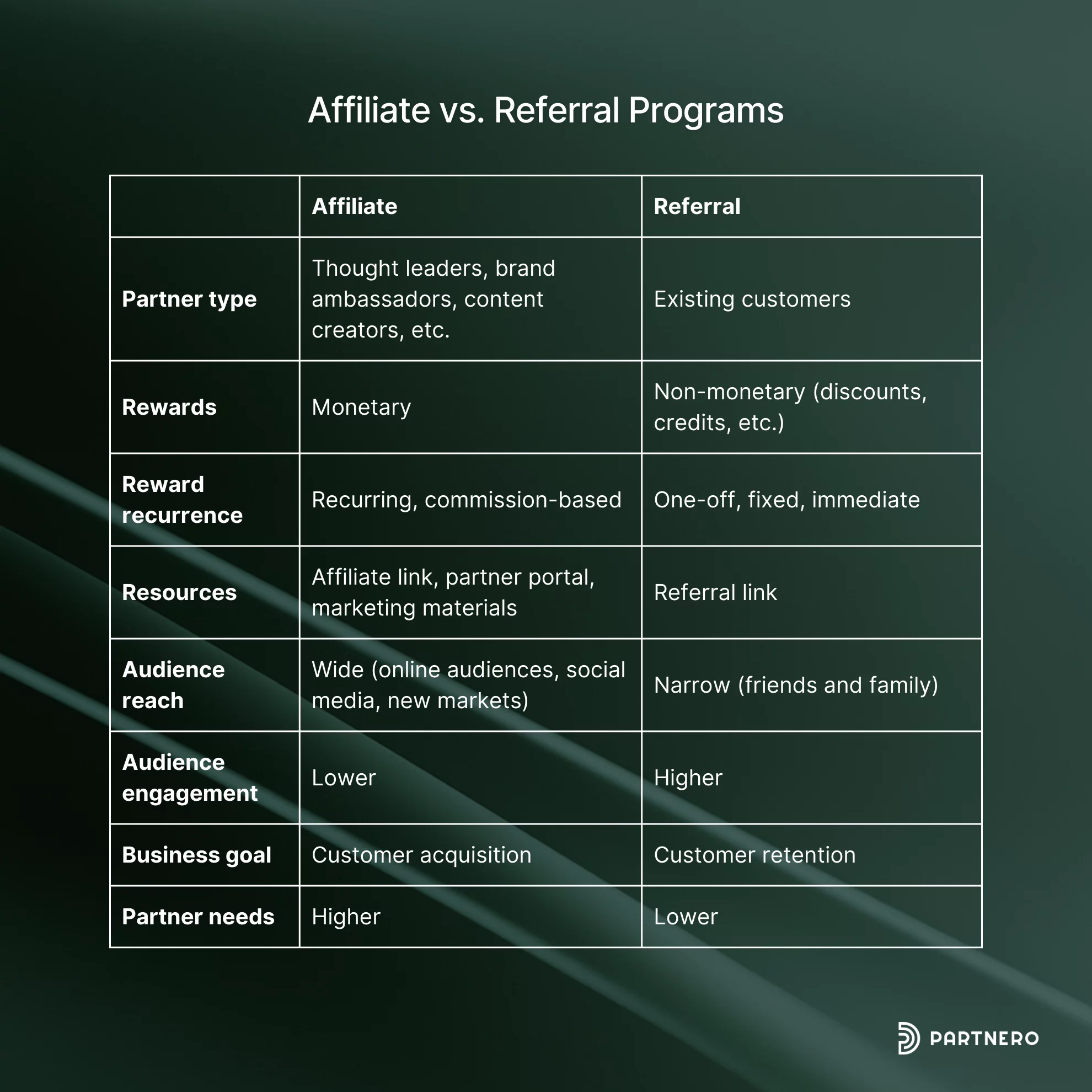
Executives love asking where the line sits between partner programs and affiliate programs. The simplest explanation is that affiliate programs are performance-driven, typically high-volume, low-touch, and optimized for transactional outcomes. Partner programs, on the other hand, operate across the entire lifecycle – technical alignment, co-marketing, co-selling, enablement, and post-sale value creation.
But the messy truth? Many companies try to force affiliate models into partnership ecosystems, creating hybrid structures that satisfy no one. Affiliates don’t want the bureaucracy of partner programs. Partners don’t want the commoditization of affiliate models.
Here’s a quick comparison that usually makes it clearer.
| Model | 🤝 Partner Program | 🔗 Affiliate Program |
|---|---|---|
| Relationship depth | Collaborative, multi-layered | Transactional, performance-only |
| Typical participants | Agencies, consultants, tech vendors | Review sites, influencers, publishers |
| Touchpoints | Co-selling, co-marketing, integrations | Click-to-sale attribution |
| Incentives | Multi-tiered, strategic, recurring | CPA or rev-share per action |
| Ideal for B2B? | Absolutely | Sometimes, but not always |
The nuance matters because designing the wrong model leads to costly resets later. I’ve seen entire programs relaunched because they were architected with the wrong relationship philosophy from day one.
The Bar for Excellence Has Risen Dramatically
Partner programs used to get away with vague documentation and optimistic spreadsheets. Not anymore. Executives expect measurable outcomes. Partners expect revenue reliability. And boards expect ecosystems to outperform traditional acquisition channels.
Ignore the hype around “set-it-and-forget-it” partner automation. There’s no such thing. Effective partner programs need ongoing operational care, continuous partner enablement, and rigorous performance reviews. And to be frank, far too many companies underestimate the headcount and cross-departmental coordination required to maintain ecosystem performance.
Partners disengage when communication stalls. Sellers get frustrated when attribution clashes with quota credit. Marketing gets confused when co-marketing requests pile up with no framework to prioritize them. This is the real operational weight of partner programs, and pretending otherwise leads to painful gaps.
Where Partner Marketing Actually Moves the Needle
Partner marketing is not about blasting shared newsletters or handing out logos. It’s about embedding your solution into the partner’s business motion so deeply that recommending you becomes instinctive. This requires a blend of enablement, strategic alignment, and shared customer narratives.
The most impactful partner marketing initiatives I’ve seen were not flashy campaigns; they were small, meticulously crafted moments of value delivery. A partner portal tailored to their workflows. A certification path that actually teaches something useful rather than padding a brand’s ego. A co-selling playbook written in the partner’s language, not internal jargon.
When done right, it accelerates deals, strengthens renewals, and helps partners position themselves as experts in front of their clients. But again, this requires clarity and consistency – the two attributes most programs claim to have but rarely demonstrate.
Designing the Right Structure for a Modern Partner Program
Have you noticed how partner program examples tend to fall into the same tired templates? Tiered levels, certification badges, revenue requirements, MDF allocations. These are helpful starting points, but they don’t define a modern partnership strategy. They merely support it.
A partner program must be treated like an evolving system. The moment you assume it’s “done,” it begins to degrade. The best programs today incorporate flexible tracks – referral, reseller, integration, service delivery – but without forcing partners into categories they outgrow.
One practical way to think about it? Build around behaviors, not titles. Identify the activities that truly correlate with partner revenue contribution, whether that’s training engagement, technical certification, opportunity registration, or customer success collaboration.
Here’s a simple way to frame it:
| Activity Type | 🔧 Technical Value | 📈 Revenue Value | 🧭 Strategic Value |
|---|---|---|---|
| Integration readiness | High | Medium | High |
| Co-selling | Medium | High | Medium |
| Referral generation | Low | High | Low |
| Implementation services | Medium | Medium | High |
Once activities map to value, incentive structures follow naturally. You reward the behaviors that drive outcomes. You encourage partners to mature into higher-value categories. You reduce friction because each action is tied to a clear rationale.
Addressing the Obstacles No One Likes Talking About
Partnership leaders know the battles.
Attribution wars. Compliance headaches. Disconnected data. Partners who vanish for months and return expecting priority support. Sellers who love partners when they bring deals, yet treat them like rivals when quota pressure intensifies. Technology integrations that promise seamlessness but end up exposing every workflow inefficiency.
It’s frustrating, and it’s also normal. Successful partner programs are not those that avoid friction; they are those that manage it gracefully. The best leaders create transparency around deal flows, maintain predictable support structures, and automate everything that can reasonably be automated without sacrificing relationship depth.
One particularly overlooked obstacle is partner burnout. Not on your side – on theirs. B2B partners juggle dozens of vendors competing for their attention. If you cannot articulate, quickly and convincingly, why your solution deserves priority, you lose mindshare before you even begin.
The How: Building a Partner Program That Actually Works
Building a partner program is not enigmatic. But it is demanding. It requires brutal honesty about your product’s strengths, your operational maturity, and the kind of ecosystem you’re trying to build.
The architectural essentials usually fall into four categories:
- A clear value exchange that goes beyond commissions.
- Operational infrastructure that doesn’t collapse when partner volume increases.
- Tracking and attribution that partners trust.
- A strategic roadmap showing how partners can grow, not just transact.
Ignore these, and your program becomes another dormant initiative in a forgotten Google Drive folder. Respect them, and you build something resilient.
Automation helps, especially when you’re wrangling renewals, co-selling motions, and partner-generated opportunities. But automation can only enhance what already works. It can’t fix unclear incentives or incoherent communication.
And here’s the bottom line: partner programs succeed not because they are beautifully designed but because they are consistently nurtured. Consistency is the real differentiator.
A Final Thought
As ecosystems become more entangled and influence becomes harder to map, partner programs will either define a company’s growth trajectory or expose its operational weaknesses. The question isn’t whether partnerships matter in 2026 – they undeniably do. The real question is whether the structure supporting your partner program is built for the world you’re operating in now or the world you wish still existed.
Have you looked at your partner strategy lately and honestly asked whether it reflects reality or nostalgia?