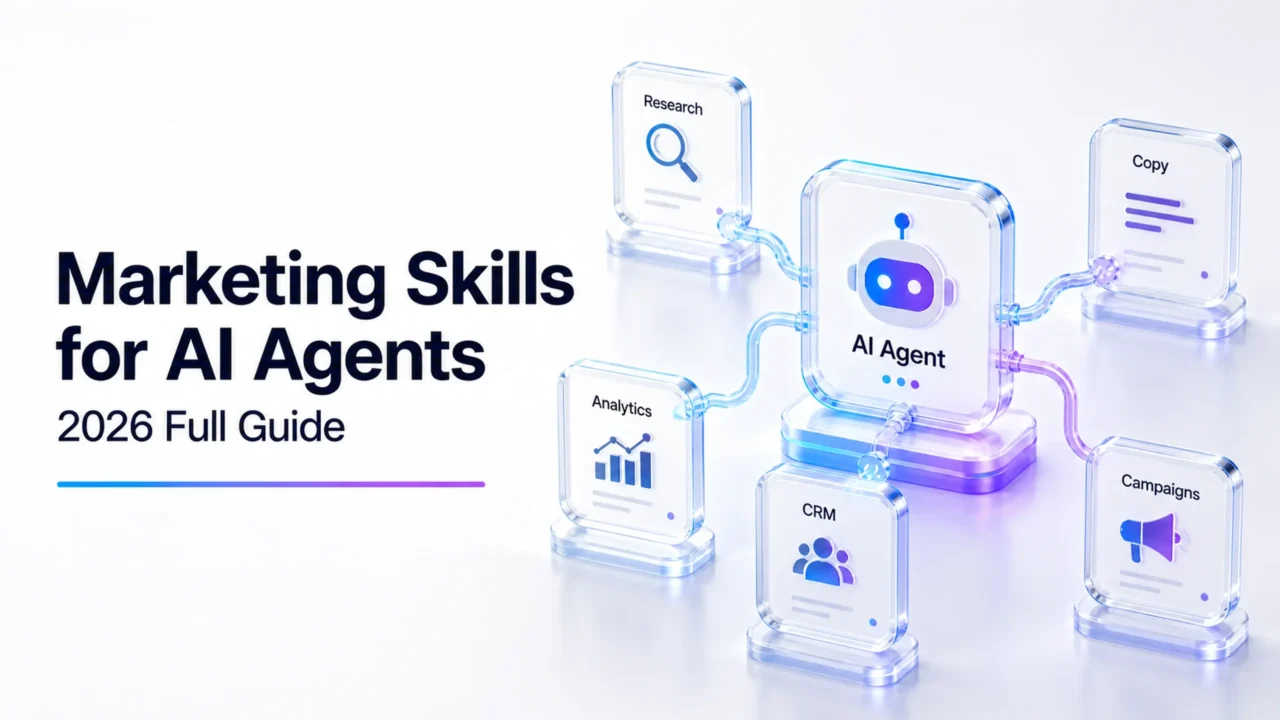
Marketing Skills for AI Agents: 2026 Full Guide

Last Updated on August 27, 2026 by Triumphoid Team
I run five content properties, and somewhere between last spring and now I stopped writing prompts for repeatable marketing work and started writing skills instead. Not a metaphor — actual SKILL.md files sitting in a folder, with YAML frontmatter and a trigger description, that an agent reads before it touches anything. I’m past 40 of them now across SEO, content production, and reporting. The gap between “here’s a decent prompt” and “here’s a skill” turned out to be bigger than the agent hype cycle gives it credit for, and it’s the reason I finally sat down to write the long version of this — the guide I wish someone had handed me before I burned two weekends reinventing things marketing skills already catalogs.
- A marketing skill is a packaged, versioned instruction set — usually a
SKILL.mdfile with YAML frontmatter — that tells an AI agent exactly how to do one specific marketing task correctly, every time, instead of relying on a fresh prompt each session. - AI agents load skills dynamically. The agent searches short skill descriptions for a keyword or trigger match first, then reads the full instructions only when the task calls for it — which keeps context clean and results consistent across runs.
- Skills, MCP servers, and prompts solve different problems. Skills carry judgment and process; MCP servers carry live data and actions; prompts are for one-off exploration. A real marketing stack layers all three.
- Libraries like Marketing skills exist because writing a skill that triggers reliably takes several rounds of iteration — it’s not a one-shot exercise.
- Any skill with write access to a CRM, ad account, or ESP needs a dry-run and confirmation layer before it goes near production data. More on that below, the hard way.
What Are Marketing Skills for AI Agents? (The Definition That Actually Matters)
A marketing skill is not a prompt with a nicer name. A prompt lives inside one conversation, gets rewritten from memory every time you need it again, and drifts a little each time you retype it. A skill is a file. It has a name, a description, a license, a list of tools it’s allowed to touch, and — this is the part people skip — a description written specifically for a machine to match against, not for a human to read as marketing copy.
That description field carries more weight than anything else in the file. It’s what the agent’s router compares against the task in front of it before deciding whether to open the skill at all. Get it too vague (“helps with email stuff”) and the skill never fires when you need it, or fires when you don’t. Get it specific — the exact phrases a person would type, the exact situations it applies to, and just as important, what it’s not for — and the agent picks it up reliably, session after session, without you having to explain SPF record formatting for the fortieth time.
---
name: email-deliverability-auditor
description: |
  Audits SPF, DKIM, and DMARC records, sender reputation signals,
  and recent bounce/complaint trends before a campaign sends.
  Use when the user says "check deliverability," "will this land
  in spam," "audit our sending domain," or "why is our open rate
  tanking." Not for building the email copy itself — that's a
  separate skill.
license: MIT
allowed-tools:
  - Read
  - Bash
  - WebFetch
---
Notice what’s doing the real work there: the negative example at the end (“not for building the email copy itself”). That one line has saved me more mis-triggers than anything else I’ve added to a skill file. Without it, an agent asked to “fix this email” will sometimes open the deliverability skill because the word “email” matched, then hand back an SPF audit when what I actually wanted was better subject lines.
Why Marketing Skills Beat Prompt Engineering for Repeatable Work
I used to keep a running doc of “good prompts” — the SEO brief prompt, the ROAS benchmark prompt, the FAQ-schema prompt. It looked organized. It wasn’t. Every time I pasted one into a fresh chat, I’d tweak a word here, add a constraint there, and by month three the doc had six slightly different versions of the same prompt and no way to know which one produced which output six weeks ago. There’s no version history on a paste.
A skill fixes that by accident, not by design — it’s just a file, and files go in git. Every change to how I want a content brief structured is a diff. If a skill starts producing worse output after an edit, I can see exactly what changed and roll it back. Try doing that with a prompt you half-remember typing into a chat window three weeks ago.
There’s a second, less obvious benefit: skills are shareable in a way prompts rarely are. I can hand a teammate a folder of 40 marketing skills and they get the same triggering behavior I get, immediately, because the instructions live outside any one person’s chat history. Prompt libraries pass around as screenshots and Slack pastes. Skills pass around as a directory you drop in and point the agent at.
How AI Agents Actually Load and Use a Skill (Under the Hood)
This is the part that trips people up: an agent doesn’t load every skill’s full contents into context before it starts working. If it did, a stack of 40 marketing skills would eat the context window before you’d typed your first sentence. Instead, most agent frameworks — Claude’s included — keep only the short name-and-description pair for each available skill loaded up front, then search across those descriptions the moment a task comes in. Only the one or two skills that actually match get their full instructions pulled into context.
That’s why the description-writing discipline from the last section matters so much more than it looks like it should. The agent is making a routing decision off a paragraph, sometimes off a single sentence, before it ever sees the rest of the file. Write it like you’re pitching the skill to a distracted colleague who’ll only read the first line.
10 Categories of Marketing Skills Every Agentic Stack Needs
My own skills folder sorts roughly into ten buckets. Not every property needs all ten on day one — an affiliate site cares about SEO and reporting skills long before it needs an influencer-fit-scoring skill — but this is the map I’d hand someone starting from zero.
1. SEO & content skills
2. Paid ads skills
3. Email & lifecycle skills
4. Social & community skills
5. Analytics & reporting skills
6. Brand & narrative skills
7. Launch & PR skills
8. Local & maps skills
9. Influencer & creator skills
10. Governance & compliance skills
Marketing Skills vs. MCP Servers vs. Plain Prompts: What’s the Difference?
People use these three terms interchangeably and it causes real confusion when a team is deciding what to build. They’re not competitors — they’re layers, and a mature agentic marketing stack ends up using all three at once, for different jobs.
What they’re good at: encoding a repeatable process or judgment call — “here’s how we structure a content brief,” “here’s our five-point deliverability check.”
- File-based, versionable, shareable across a team
- No live data access on their own — they instruct, they don’t connect
- Best for process, formatting standards, and decision frameworks
What they’re good at: giving an agent live access to a real system — your CRM, your rank tracker, your ad account.
- Persistent connection, real read/write capability, needs auth
- Higher setup cost, but nothing else gets you current data
- Best for anything that changes hour to hour
What they’re good at: one-off exploration, something you’ll ask exactly once, or testing an idea before it’s worth formalizing into a skill.
- Zero setup, lives in one conversation, doesn’t persist
- No audit trail, no version history, drifts with every retype
- Best for “I just want to try this one time”
| Dimension | Marketing skill | MCP server | Plain prompt |
|---|---|---|---|
| Reusable across sessions | Yes — file-based | Yes — persistent connection | No |
| Live data access | No, by itself | Yes | No |
| Setup effort | Medium (write once, test, iterate) | High (server + auth) | Low, but not durable |
| Auditable / versioned | Yes — a file in git | Partially — server config only | No |
| Best fit | Repeatable process, judgment calls | Real-time data, actions on live systems | One-off exploration |
Building Your Own Marketing Skill: A Practitioner’s Framework
The framework I actually use, in order:
- Name it for the task, not the tool.
content-brief-generator, notclaude-brief-helper. You’ll thank yourself when you switch models in two years. - Write the description as if it’s the only thing the router ever sees — because it usually is. Include the exact phrases a person would type, and one explicit line about what the skill is not for.
- Scope
allowed-toolsas tightly as the task allows. A skill that only reads files shouldn’t have bash access “just in case.” - Test with adversarial phrasing — the vague version, the version with a typo, the version that sounds like it should trigger a different skill. If it doesn’t survive that, it’s not done.
- Version it. A changelog comment at the bottom of the file costs nothing and saves a debugging session six months from now.
marketing-skills/
├── seo-content-brief/
│   └── SKILL.md
├── email-deliverability-auditor/
│   └── SKILL.md
├── roas-benchmark-synthesizer/
│   ├── SKILL.md
│   └── reference/
│       └── sourcing-standards.md
└── crm-segment-builder/
    ├── SKILL.md
    └── scripts/
└── dry_run.py✓ What makes a description trigger reliably
- Exact phrases the user actually types, not paraphrases
- Named entities and file types where relevant
- An explicit “not for X” line to prevent overlap
- One sentence, front-loaded — don’t bury the trigger in paragraph three
✗ What kills trigger accuracy
- Vague one-liners (“helps with marketing tasks”)
- No example phrasing at all
- Scope that overlaps another skill with no disambiguation
- Burying the actual trigger condition after three paragraphs of context
The Failure Mode Nobody Talks About: When a Marketing Skill Goes Wrong
Here’s the one I’m least proud of. I built a CRM segment-builder skill with write access, meant to re-tag contacts by lifecycle stage based on recent activity. It worked fine in testing against a 200-row sample export. It did not work fine against the live list, because the live list had a referral_source field with a value my sample export didn’t happen to include — a legacy import tag from a platform we’d stopped using two years earlier. The skill’s logic treated that unrecognized value as “unknown,” and “unknown” fell through to a default branch that mass-reassigned lifecycle stage instead of leaving it alone.
By the time I noticed — a colleague asked why a segment that should’ve had roughly 900 people in it suddenly had 6,842 — the write had already gone through. Restoring from the CRM’s backup and manually cross-checking the diff took about three and a half hours, most of it spent making sure the restore hadn’t clobbered anything legitimate that happened in the window between the bad write and the restore.
Where to Find Ready-Made Marketing Skills
Building every skill from scratch is a reasonable choice if your workflows are genuinely proprietary. For most of the common stuff — SEO audits, ad account structure, email deliverability checks — someone has already been through the painful iteration rounds. Marketing-skills.com maintains a growing directory of these organized by discipline, which is a faster starting point than a blank SKILL.md and a Friday afternoon.
I don’t install anything from a directory without reading the whole file first, though — not just the description. Here’s the checklist I actually run:
- Read the full instructions, not just the description — the description is a pitch, the body is what actually runs
- Check
allowed-toolsfor anything broader than the stated purpose needs (a “content brief” skill shouldn’t ask for bash) - Search for hardcoded URLs, webhooks, or API endpoints that aren’t yours
- Check the license terms before you fold it into anything client-facing
- Run it once on throwaway data before you run it on anything real
Governance: Keeping Marketing Skills Safe Before You Give Them Write Access
After the CRM incident, this became a non-negotiable checklist for anything with write access, not a nice-to-have:
- Dry-run mode by default. The skill shows a diff of what would change before anything commits.
- Scoped credentials. A skill that updates email tags doesn’t get the API key that can also send campaigns.
- A human confirmation gate on anything destructive or bulk — mass tagging, mass deletion, mass sends.
- An audit log that survives outside the chat session, so “what changed and when” is answerable a month later.
- Rate limits on anything that can hit an external API in a loop — a runaway retry pattern on a paid API is its own kind of expensive mistake.
Is Your Marketing Task Ready to Become an AI Agent Skill? (Interactive Check)
Not everything deserves a skill. Something you do once a quarter probably doesn’t earn the setup time. Check the boxes that apply to a task you’re considering:
FAQ: Marketing Skills for AI Agents
What’s the difference between a marketing skill and a custom GPT or prompt template?
Do I need to know how to code to build a marketing skill?
Can marketing skills replace an SEO or PPC specialist?
What’s the risk of using someone else’s pre-built marketing skill?
How is a marketing skill different from an MCP server?
Where can I find a library of pre-built marketing skills?
The Bottom Line on Marketing Skills for AI Agents
The stack that actually works isn’t “replace your prompts with skills and call it done.” It’s skills for the repeatable judgment calls, MCP servers for anything that needs live data, and plain prompts for the one-off idea you’re not sure is worth formalizing yet. Start with whatever task you re-explain most often in fresh chats — that’s the tell that it’s already costing you more than the hour it’ll take to write it down properly once.