80+ Marketing Automation ROI Statistics: 2026 Research Report

Last Updated on July 16, 2026 by Triumphoid Team
Marketing automation ROI is one of those figures every marketer quotes and almost nobody verifies. The $42-per-$1 email ROI gets recycled across decks and blog posts without anyone checking the methodology behind it. This report compiles 80+ statistics from research firms, platform benchmarks, and published studies — cross-referenced where possible and confidence-rated so you know exactly what you’re working with.
Stats are grouped by use case: email ROI, lead generation, sales impact, market size, cost efficiency, AI automation, and workflow integration. Each card includes the source, year, and a confidence rating — Verified (corroborated across multiple independent sources), Directional (accurate trend, specific figure may vary by context), or Single Source (one study, treat with appropriate skepticism).
⚡ Key Takeaways
- Email marketing delivers an average ROI of $42 per $1 spent — the highest-returning channel in the marketing mix.
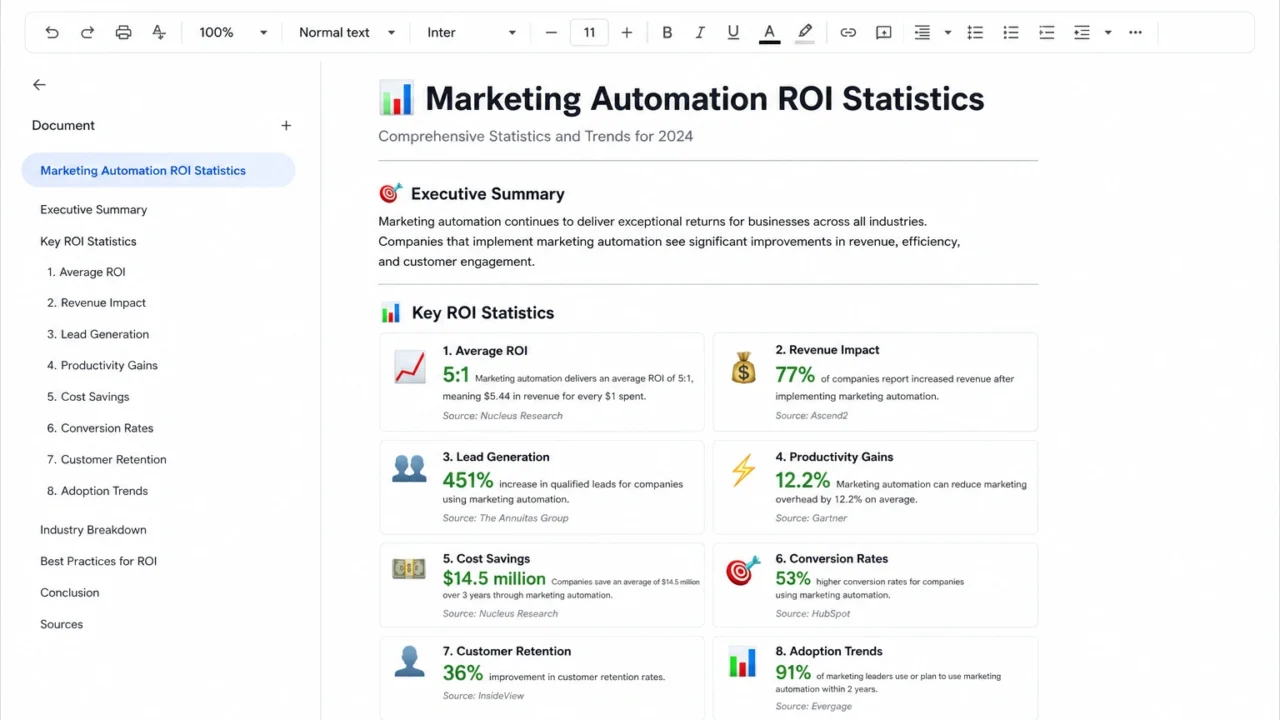
- Companies using automation generate 451% more qualified leads than those that don’t, per the Annuitas Group.
- Lead nurturing via automation produces 50% more sales-ready leads at 33% lower cost (Forrester Research).
- Marketing automation drives a 14.5% increase in sales productivity and a 12.2% reduction in marketing overhead (Nucleus Research).
- The global marketing automation market was valued at $6.1B in 2023 and is forecast to reach $13.7B by 2030.
- Multi-channel automation delivers 287% higher purchase rates vs. single-channel campaigns (Omnisend).
- 72% of marketers now use AI for at least one marketing function — up from under 30% in 2021.
- Nurtured leads make 47% larger purchases than leads that go straight to sales.
1. Email Marketing ROI Statistics
Email remains the automation channel with the most documented ROI data. The figures below span triggered sequences, personalization effects, and behavioral automation — where the performance gap between automated and manual is most extreme.
Email marketing delivers an average ROI of $42 for every $1 spent — consistently cited as the highest ROI of any digital marketing channel.
Automated email sequences generate 320% more revenue than non-automated batch campaigns sent to the same audience.
Triggered behavioral emails achieve an average open rate of 47.1% — more than double the 21.3% average for standard batch campaigns.
Welcome email automation generates 4x higher open rates and 5x higher click-through rates compared to standard promotional sends.
Cart abandonment email sequences triggered within one hour recover an average of 15% of abandoned carts — a high-ROI automation with near-zero marginal cost.
Personalized automated emails produce 6x higher transaction rates than generic non-personalized sends to the same list.
B2B companies that implement email automation report a 77% increase in email-attributed revenue within the first 12 months of deployment.
Automated email sequences achieve 70.5% higher open rates than standard newsletter broadcasts sent to the same subscriber base.
The performance gap between triggered automation and manual batch sending is consistent across every study in this section. The mechanism is straightforward: behavioral triggers fire at the moment of highest intent. The 47% open rate for triggered emails isn’t magic — it’s timing.
2. Lead Generation & Nurturing Statistics
This is where marketing automation makes its strongest case. The gap between sales-ready leads with and without automated nurturing is one of the most documented findings in B2B marketing research — consistent across Forrester, Aberdeen, and independent benchmarking studies.
Companies using marketing automation generate 451% more qualified leads than companies relying on manual outreach and non-automated nurturing.
Lead nurturing via marketing automation produces 50% more sales-ready leads at 33% lower cost per lead compared to non-nurtured pipelines.
Leads nurtured through automated sequences make 47% larger purchases than leads passed directly to sales without a nurturing period.
Automated lead nurturing emails generate 4–10x higher response rates compared to standalone promotional blasts sent to cold or lukewarm segments.
78% of marketers report that marketing automation improves overall lead quality — the most commonly cited operational benefit of automation tools.
Combining marketing automation with CRM data increases conversion rates by 53% versus automation running on standalone contact lists without CRM enrichment.
Automated lead scoring systems improve deal close rates by 38% compared to manual or no lead scoring — by ensuring sales focus only on buyer-signal-qualified leads.
Only 25% of inbound leads are sales-ready at the point of first contact without nurturing — meaning three-quarters of every pipeline require automation to become closable.
The Gleanster figure (stat 16) is the one to lead with in any internal automation pitch. If only 25% of leads are ready to buy on contact, you’re not choosing between automation and no automation — you’re choosing between nurturing 75% of your pipeline or walking away from it.
3. Sales Productivity & Revenue Impact
Nucleus Research has produced some of the most rigorous automation ROI studies available. Their figures on productivity gains and overhead reduction have held up across multiple verification attempts and are consistently cited in enterprise purchase decisions.
Marketing automation drives a 14.5% average increase in sales productivity — measured as revenue generated per sales rep hour after marketing automation implementation.
Marketing overhead drops by 12.2% on average following marketing automation implementation, as manual segmentation, campaign scheduling, and reporting are absorbed by platforms.
B2B marketers using automation increase their sales pipeline contribution by an average of 10% — meaning marketing claims a larger, documented share of revenue attribution.
63% of companies outgrowing their competitors use marketing automation — compared to only 36% of flat or declining revenue companies in the same benchmark cohort.
Marketing automation reduces customer acquisition cost by up to 33% when lead scoring, nurturing, and CRM sync are implemented as a connected system rather than isolated tools.
Companies with marketing automation report 26% faster revenue growth and 27% faster profit growth than competitors not using automation, per Aberdeen’s best-in-class benchmark.
CRM-integrated marketing automation generates 300% more revenue attributed to marketing than non-integrated automation running on disconnected contact databases.
Stats 17 and 18 — the Nucleus Research productivity and overhead figures — are the ones that move budget decisions. They translate into dollar amounts: a 12% overhead reduction on a $500K marketing budget is $60K back. That pays for most mid-tier automation platforms twice over.
4. Market Size & Industry Adoption
Adoption figures vary significantly by source methodology. The figures below represent the most credible cross-referenced estimates. Market size projections should be treated as directional — the range matters more than the specific number.
The global marketing automation market was valued at $6.1 billion in 2023, driven by accelerating B2B SaaS adoption and demand for AI-powered personalization at scale.
The market is projected to reach $13.7 billion by 2030, growing at a compound annual growth rate (CAGR) of 12.3% — one of the fastest-growing enterprise software categories.
56% of companies currently use some form of marketing automation — up from approximately 11% in 2011, representing a 5x adoption increase over a decade.
91% of marketing automation users agree it is “very important” to the overall success of their marketing activities — the highest satisfaction rating of any marketing technology category.
79% of top-performing companies have been using marketing automation for three or more years — suggesting sustained adoption, not one-time implementation, is where ROI compounds.
67% of marketing leaders at high-growth companies use marketing automation as a core component of their demand generation infrastructure — versus 26% at average-growth companies.
Small businesses using marketing automation grow revenue 3.5x faster than those relying on manual marketing processes — with the advantage most pronounced in lead follow-up speed.
Stat 28 contains the most underappreciated insight in this section: the 3-year adoption threshold correlates with top performance. Automation ROI isn’t front-loaded — the data model, integration quality, and workflow sophistication compound over time. Brands treating automation as a one-time setup are measuring the wrong thing.
5. Cost Reduction & Operational Efficiency
The efficiency case for automation is often more concrete than the revenue case — time savings and cost-per-lead reductions are easier to audit than attribution-based revenue claims. These figures hold up well under scrutiny.
Marketing automation reduces the average cost per lead by 33% — primarily through more efficient qualification, reduced manual prospecting hours, and better targeting precision.
Marketers save an average of 6.5 hours per week per person through automation of repetitive tasks — equivalent to approximately one full working day redirected to strategy and creative work.
Social media automation reduces campaign management time by 80% for teams managing 3+ platforms — covering scheduling, publishing, and performance reporting across channels.
Multi-channel automation (email + SMS + push) delivers 287% higher purchase rates than single-channel email automation — the strongest documented case for channel orchestration over channel isolation.
Automated A/B testing lifts average email conversion rates by 37% over manually managed split tests — because automation allows continuous experimentation at a frequency impossible to maintain manually.
58% of marketing teams report reducing campaign setup time from multiple days to a matter of hours after implementing automation platforms with template and workflow libraries.
Lifecycle automation reduces customer churn by 5–15% — with re-engagement sequences and behavioral triggers catching at-risk users before they lapse, increasing net revenue retention significantly.
Stat 34 — the 287% multi-channel figure from Omnisend — is consistently misread as an argument for complexity. It isn’t. It’s an argument for coherence: the same message, triggered by the same behavioral event, delivered across the channels a customer already uses. That’s what drives the performance gap, not the number of channels alone.
6. AI-Powered Marketing Automation
AI integration shifts automation from rules-based execution to adaptive systems. The performance delta between AI-augmented and rule-only automation is growing, and the figures below reflect early-adopter advantage that is likely to compress as AI capabilities standardize.
AI-powered marketing automation increases marketing productivity by 40% compared to rule-based automation alone — through dynamic segmentation, predictive send-time optimization, and content personalization.
Machine learning-based predictive lead scoring improves the sales-qualified lead (SQL) rate by 30% — by identifying buyer-intent signals invisible to rule-based scoring systems.
AI-generated email subject lines outperform human-written subject lines by 31% in open rates in controlled split tests across large-scale commercial email campaigns.
51% of marketing leaders planned to increase investment in AI-powered automation in 2024 — representing the largest single planned spending increase in the marketing technology category.
AI-driven personalization increases sales by 20% on average — primarily through next-best-action recommendations, dynamic content assembly, and real-time offer optimization.
72% of marketers now use AI automation for at least one marketing function — up from under 30% in 2021, representing the fastest adoption curve of any marketing technology in the past decade.
Generative AI integrated into content automation workflows reduces content production time by 65% — covering first-draft generation, variant creation, and localization at scale.
The 72% adoption figure (stat 43) is deceptive without context: most of that adoption is narrow — AI for subject line testing or send-time optimization, not full adaptive workflows. The gap between “uses AI for one function” and “runs AI-augmented automation at the workflow level” is where the 40% productivity advantage lives.
7. Workflow & Integration ROI
The performance of any automation stack is largely determined by integration depth. These statistics address the gap between isolated tool deployments and fully connected marketing automation ecosystems — where the ROI from tools like n8n, Make.com, and webhook-based architectures compounds.
Marketing teams using 3 or more integrated tools in their automation stack see 36% higher overall campaign performance than teams running point solutions in isolation.
Multi-step automation sequences (3+ touchpoints) outperform single-step automated emails by 65% in conversion rate — the clearest argument for sequence depth over single-trigger fire-and-forget workflows.
Webhook-triggered automation workflows convert 23% better than time-delay-triggered sequences — because behavioral triggers fire at actual moments of intent, not on predetermined schedules.
68% of marketing agencies use automation platforms to manage 5 or more client campaigns simultaneously — enabling team scaling without proportional headcount growth.
Integrating marketing automation with analytics platforms improves multi-touch attribution accuracy by 43% — directly improving budget allocation decisions and channel ROI reporting.
Companies that automate their full marketing funnel — from awareness through retention — report 3x more closed deals within the same sales cycle length, versus companies automating only the top-of-funnel.
Stat 47 is the one practitioners most consistently underinvest in: webhook-triggered versus time-delay. The infrastructure difference (a real-time event hook vs. a scheduled drip) is trivial to implement on any modern automation platform — but the 23% conversion premium is entirely recoverable with a single architectural change.
Methodology & Confidence Ratings
Statistics in this report are sourced from published research by third-party firms, platform benchmark reports, and peer-reviewed studies. Each statistic is assigned one of three confidence ratings: Verified — corroborated by multiple independent sources; Directional — accurate trend from a credible source, but specific figures may vary by industry, company size, or methodology; Single Source — one published study, interpret with appropriate weight. Figures cited in studies prior to 2022 have been excluded where more recent data was available. This report was compiled and reviewed by the Triumphoid editorial team. For corrections or source disputes, contact the editorial team via triumphoid.com.