How to A/B Test Your Website with AI: What Actually Changes (and What Doesn’t)

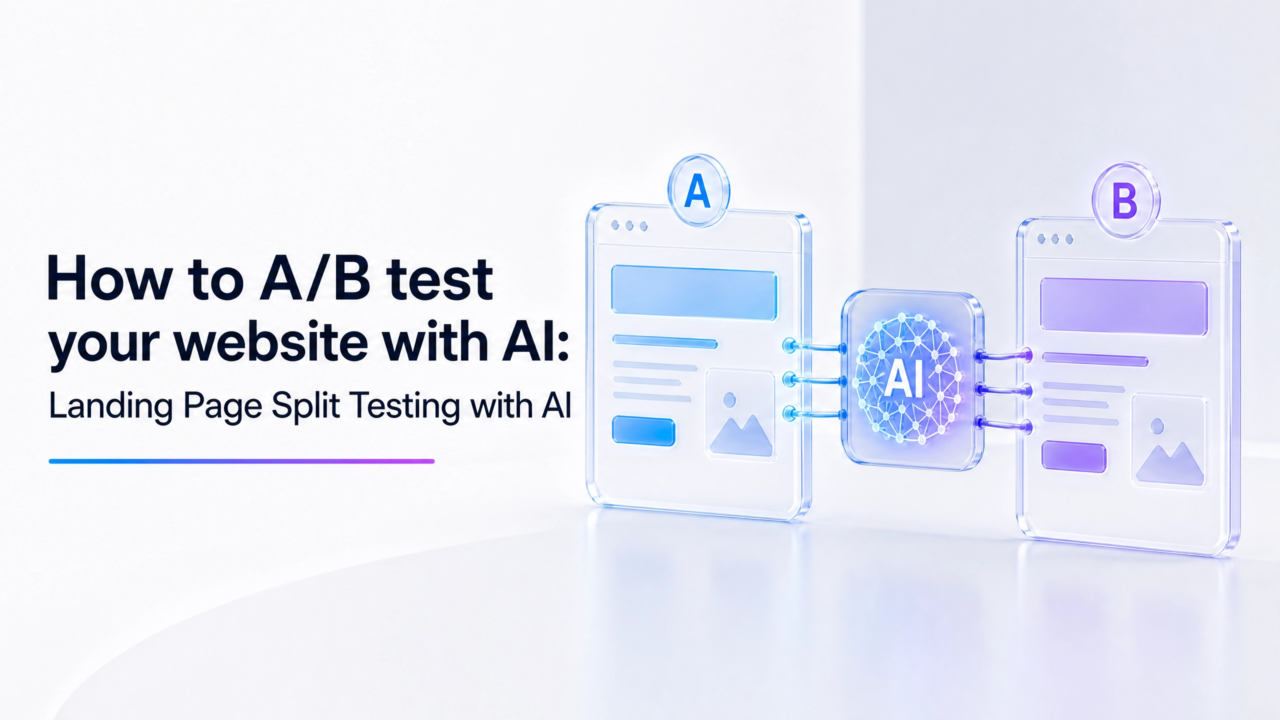
A/B testing with AI means using a language model to generate, critique, and prioritize test variants — before you run a single test. It doesn’t replace your testing tool, it doesn’t bypass the need for traffic, and it won’t tell you which variant wins. What it does is get you to a better hypothesis faster, which matters more than most people realize because the hypothesis is where most tests fall apart.
I’ve been running split tests on landing pages for about four years. The honest truth is that the majority of tests I ran before I started using AI to generate variants produced results I couldn’t act on — either the lift was too small to reach significance given my traffic, or I was testing things that didn’t matter much. The shift wasn’t in the testing infrastructure. It was in what I decided to test.
Here’s the full setup.
The Problem Most A/B Testing Guides Skip Over
Before anything else about AI, there’s a math problem worth understanding, because it changes how you think about every part of this.
To detect a 15% lift on a landing page converting at 3% — which is a real, meaningful improvement — you need roughly 5,400 visitors per variant at 95% confidence. That’s about 10,800 visitors across both arms of the test. If your page gets 2,500 visits a month, you’re looking at a minimum of four weeks per test before the numbers mean anything. Run one test a month and you get 12 results a year. Lose a few to inconclusive results and you’re making maybe 7–8 real decisions annually.
This is why hypothesis quality matters so much. Every bad hypothesis is a month wasted. AI doesn’t fix the traffic math, but it meaningfully improves the ratio of good tests to bad ones by helping you prioritize changes that are more likely to produce a detectable lift.
Two Different Ways AI Enters the Picture
These are worth separating because they often get conflated:
AI for variant generation: You use Claude, GPT-4o, or a similar model to write headline alternatives, CTA copy, value proposition framings, and page structures. You still run the test yourself in a traditional tool (VWO, AB Tasty, Convert, Optimizely). The AI generates better raw material; the testing platform runs the experiment.
AI-powered testing platforms: Tools like Mutiny, Intellimize, or Dynamic Yield use machine learning to serve personalized experiences to different visitor segments, run multi-armed bandit tests that shift traffic toward winners in real time, and in some cases flag early signals of lift. These require more setup and typically a larger traffic base to work as advertised.
For most sites under 100,000 monthly visitors, the first approach is what’s practical. The second category is genuinely useful but tends to be over-sold to audiences that don’t have the traffic volume to benefit from the adaptive allocation features.
I use the first approach. My testing tool is VWO, my variant generation tool is Claude, and the two don’t talk to each other — which is fine.
Step 1: Define What You’re Testing and Why
The temptation when using AI is to start by asking it to “generate headline variants for my landing page.” That produces mediocre output, because the model doesn’t know what hypothesis you’re testing, what the current page says, or why you think the headline might be the problem.
Before touching any AI tool, I write a brief. One paragraph, covering:
- What element is being tested
- What the current version says (or does)
- What behavior I’m trying to change (more clicks, more form completions, lower bounce)
- Why I think the current version might be underperforming
For a recent test on a SaaS product page, my brief was: “Testing the hero headline. Current version: ‘Automate your reporting workflow.’ Trying to improve trial sign-up rate, currently 2.4%. Hypothesis: the current headline describes a feature rather than an outcome. Visitors who land from paid search don’t know what outcomes to expect, so they bounce rather than scrolling to find out.”
That brief is what I hand to the AI. With that context, the variants it produces are grounded in a specific problem, not just copy shuffling.
Step 2: Generating Variants with AI
The prompt I use:
You are a conversion copywriter reviewing a SaaS landing page.

Context:
- Product: [brief product description]
- Current hero headline: "Automate your reporting workflow"
- Current conversion rate: 2.4% (trial sign-ups)
- Traffic source: Google Ads, mostly job-title targeting (ops managers, RevOps leads)
- Hypothesis: headline describes a feature, not an outcome; visitors don't see immediate value

Generate 10 alternative headlines. Requirements:
- Each should communicate an outcome, not a feature
- Vary the angle: some time-based ("in 20 minutes"), some pain-based, some social proof-framed
- Keep each under 12 words
- Do not use the words "streamline", "effortless", "powerful", or "seamlessly"
- After each headline, write one sentence explaining the conversion logic behind it

Format as a numbered list.
What comes back in about 40 seconds would have taken me 45 minutes to produce manually, and the reasoning column is genuinely useful for deciding which variants to test first. I don’t run all 10. I pick two or three with the clearest differentiated logic.
From that session, I ended up testing: “Your reports, done before your first meeting” against the control. The logic: it names a concrete time and a concrete context (the morning meeting) that the target audience — ops managers — would immediately recognize.
Step 3: Setting Up the Test in VWO
In VWO, I create a new A/B test, point it at the landing page URL, and use the visual editor to swap the headline text. No developer needed for a simple text change. For anything involving layout or above-the-fold restructuring, I use the code editor and check it across breakpoints before setting it live.
Traffic split: 50/50 on headline tests. Some guides recommend putting less traffic into the variant until early data looks promising, but that approach extends your test duration and introduces selection bias. Equal split from the start is cleaner.
Goal tracking: primary goal is the trial sign-up form submission event (tracked via the form’s confirmation page URL). Secondary goal is scroll depth past 60%, which tells me whether variant B visitors are engaging with the page before converting.
The test runs until I hit either 95% statistical confidence or 28 days — whichever comes first. I check it once a week, not daily. Checking daily leads to calling tests early, which is how you end up with false positives.
What One Real Test Looked Like
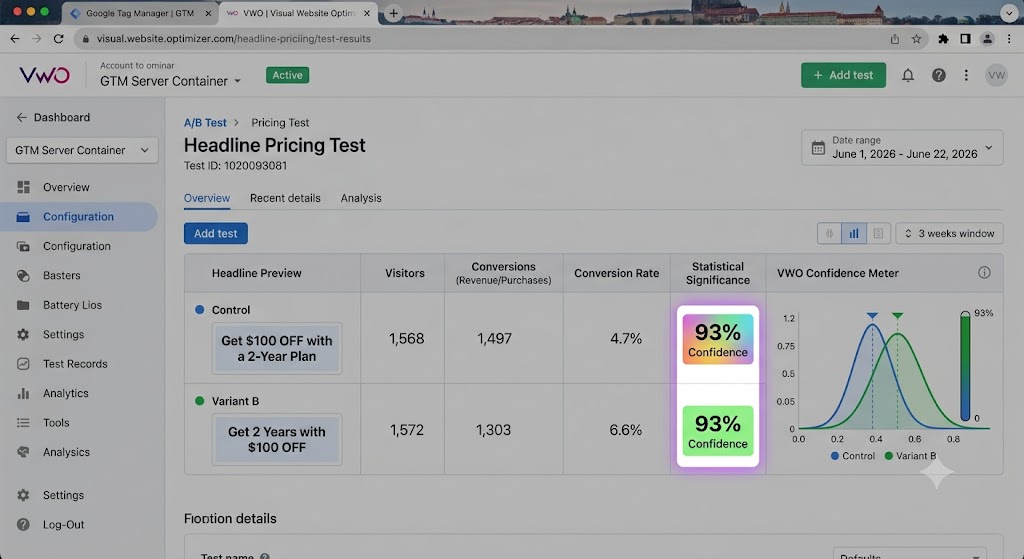
The headline test ran for 23 days. Total visitors across both variants: 3,140 (roughly what I’d expect given the page’s monthly traffic). Here’s what VWO showed at the close:
Control: “Automate your reporting workflow” — 74 sign-ups from 1,568 visitors (4.7% conversion rate)
Variant: “Your reports, done before your first meeting” — 103 sign-ups from 1,572 visitors (6.6% conversion rate)
That’s a 40% relative lift. VWO called it at 93% confidence — short of the 95% threshold I normally require, but given the size of the lift and the consistent direction across the full 23 days, I shipped the variant. If the lift had been 8–12%, I’d have waited or extended the test.
The secondary metric told an interesting story: scroll depth past 60% was nearly identical between variants (54% vs. 57%). So the headline didn’t change how much people read the page — it changed how many of the people who read it decided to sign up. That’s what I’d expect from a headline that sets clearer expectations about the outcome.
Using AI to Critique Variants Before Testing
One thing I started doing about six months ago: before finalizing which variants to test, I paste the shortlist back into Claude and ask it to argue against each one.
The prompt is simple: “For each of the following headline variants, give me the most plausible reason a visitor would read it and still not convert. Be specific about the audience (ops managers from Google Ads).”
This surfaces weak assumptions I’d missed. For the headline “Cut reporting time by 80%”, the critique was: “Ops managers have heard this claim from every analytics tool they’ve ever evaluated. Without a mechanism, it reads as marketing noise rather than a specific promise.” That feedback killed that variant before I wasted a test slot on it.
It’s not that the AI knows more about my customers than I do. It’s that asking something to systematically argue against your choices is a useful forcing function, and doing it in a conversation takes four minutes.
What AI Can’t Do Here?
I want to be specific about this because the tooling landscape is full of overselling.
AI cannot tell you which variant will win. The lift depends on your specific audience, your specific traffic source, and context that no language model has access to. I’ve generated variants that looked compelling on paper and underperformed the control by 8%. I’ve also had the opposite. The only way to know is to test.
AI-powered testing platforms that claim to “predict winners” before statistical significance is reached are mostly doing Bayesian inference with a lower confidence threshold than frequentist methods would require. That’s sometimes fine — a Bayesian approach is genuinely useful when you have limited traffic — but it’s not prediction. It’s a different tradeoff between false positive risk and test speed.
AI also doesn’t help with the part of A/B testing that most people underinvest in: qualitative research. The reason I had a good hypothesis for that headline test was a 20-minute session watching Hotjar recordings of visitors who landed and left without scrolling. I could see what they were doing. No amount of AI-generated variants compensates for not knowing what’s actually happening on your page.
The Tests Worth Running vs. the Ones That Aren’t
Based on four years of this, the changes that tend to produce detectable lifts on landing pages:
High signal: Hero headline and subheadline (the first message a visitor processes), CTA copy when the current copy is generic (“Submit”, “Get Started”), the primary value proposition framing, social proof placement and specificity, form length reduction.
Low signal: Button color, font size, most image swaps, moving elements around the page without changing what they say, minor copy edits within body paragraphs.
AI is most useful for generating variants in the high-signal category. For low-signal changes, the problem isn’t a shortage of variants — it’s that even a real win is often too small to detect with the traffic you have.
The question I ask before running any test now: if the variant wins, will the lift be large enough to reach significance in under 30 days given my traffic? If the answer is no, I don’t run the test. That might sound pessimistic, but inconclusive tests aren’t neutral — they consume time and traffic that could go toward something with a higher expected value.
FAQ
How long should an A/B test run? Long enough to reach statistical significance, or 28 days — whichever comes first. The 28-day floor captures weekly seasonality cycles. Most conversion rates fluctuate between weekdays and weekends, and cutting a test short in week two can catch a weekday traffic pattern and misread it as a meaningful result. Don’t call a test early even if it looks like a clear winner on day 10.
What’s the minimum traffic needed to run a meaningful A/B test? It depends on your baseline conversion rate and the lift you’re trying to detect. As a rough benchmark: to detect a 20% relative lift on a page converting at 3%, you need about 3,800 visitors per variant. At 1% conversion, detecting the same lift requires roughly 11,500 per variant. If your page doesn’t hit those numbers within 30 days, you either need to be testing for larger changes or accept a higher false-positive risk by using Bayesian methods.
Which A/B testing tool should I use? VWO and Convert are solid for most use cases with reasonable pricing for mid-size sites. Optimizely is more powerful but priced for enterprise. AB Tasty sits somewhere in between. Google Optimize was shut down in 2023 with no direct replacement, which is why many teams moved to these alternatives. For simple tests without a budget for dedicated tooling, Hotjar has lightweight A/B testing functionality that’s worth considering if you’re already using it for session recordings.
Can I use AI to run multivariate tests instead of A/B tests? AI is especially useful for multivariate test planning because it can generate combinations across multiple elements quickly. The problem is that multivariate tests require substantially more traffic than A/B tests — testing three headline variants against two CTA variants creates a 6-cell test that needs roughly 3x the traffic of a standard two-cell A/B test to reach significance in the same timeframe. Unless your page gets high volume, multivariate tests are hard to run correctly. A sequential series of A/B tests on individual elements usually produces more actionable results.
Does AI-generated copy perform better than human-written copy in A/B tests? In my experience, no. The lift (when there is one) comes from a better hypothesis, not from the copy being AI-generated. AI is faster at producing variants, not better at predicting what will convert. The 40% lift in the test I described above came from a hypothesis about outcome-focused messaging — an insight from watching session recordings. The AI executed that hypothesis quickly. It didn’t generate the insight.
What should I test first if I’ve never run an A/B test before? Start with the hero headline on your highest-traffic landing page. It’s the first thing visitors process, it’s easy to change without a developer, and a meaningful hypothesis is usually easy to form by watching what visitors do before they leave. Write down why you think the current headline might be the problem, generate five alternatives using the prompt structure in this post, pick the two most differentiated, and run the test. You’ll learn more from one real test than from reading ten guides about testing.
The workflow hasn’t changed fundamentally: hypothesis, variant, test, decision. What AI changed is how long it takes to go from “I think the headline might be the problem” to “here are three grounded alternatives worth testing.” That used to take an hour of copywriting and second-guessing. Now it takes a focused 10-minute prompt session. The hour is better spent on the thing AI can’t do, which is understanding what your visitors are actually experiencing.