Last Updated on January 30, 2026 by Triumphoid Team
The debate around custom software vs SaaS has resurfaced with real force in 2025, and not because founders suddenly became more technical. It’s because SaaS has quietly drifted toward rigidity while internal operations have grown more complex. Ignore the hype around “SaaS solves everything.”
The reality is often messier: SaaS is incredible when your workflows match the vendor’s worldview — and suffocating when they don’t.
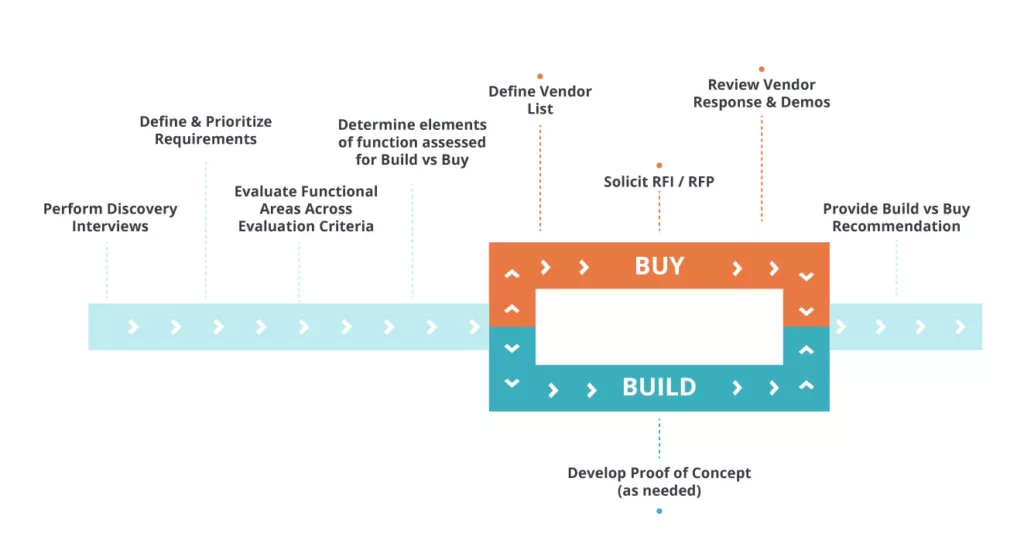
Founders now face a strategic dilemma: stick with rigid SaaS products that force process conformity, or build custom internal tools using platforms like Retool, which promise agility but introduce ownership and maintenance burdens. Neither path is universally right. Both carry hidden costs. And seasoned founders — the ones who’ve lived through a couple of product cycles — know this problem never resolves cleanly. You only choose the tradeoffs you can live with.
To visualize the tension:
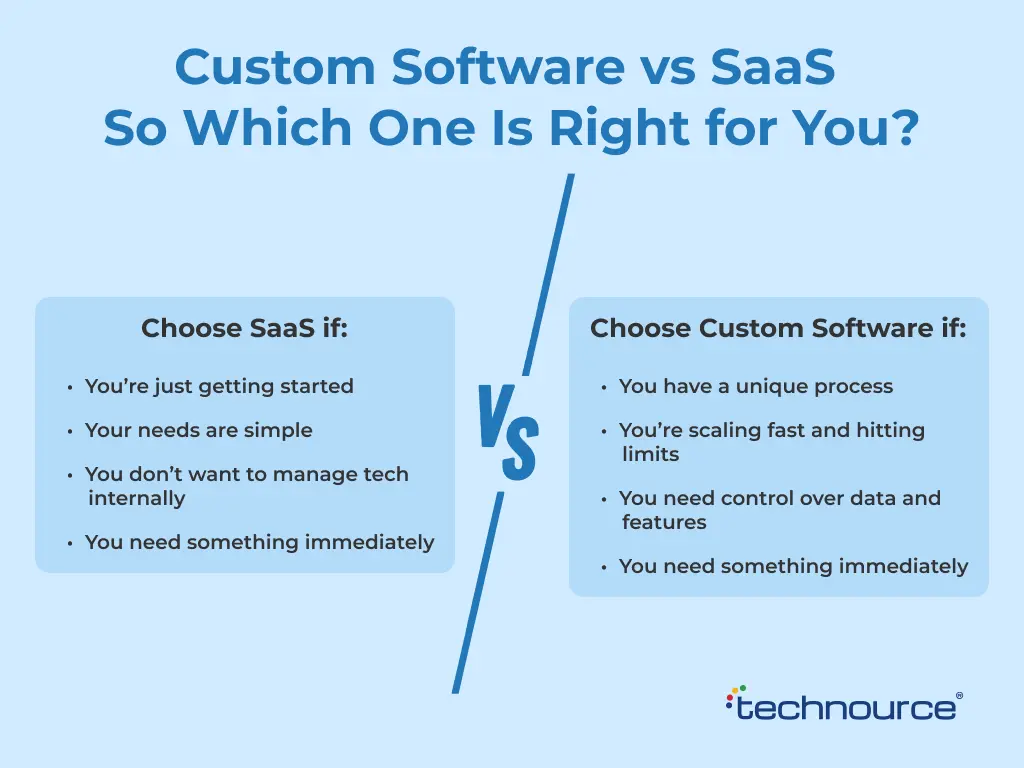
The modern startup stack used to be simple: sign up for SaaS tools, plug them together, run everything in the cloud, call it a day. But the shift toward operational automation, real-time data, and vertical specialization has exposed the limits of generic SaaS.
Founders aren’t choosing between “good SaaS” and “bad SaaS.” They’re choosing between:
- SaaS that solves 70% of the workflow and complicates the other 30%
- Custom tools that solve 100%… as long as you’re willing to maintain them
Picture a scaling founder watching their team work across five SaaS tools, none of which talk to each other well. Teams bridge gaps with Notion docs, internal spreadsheets, and daily Slack copy-pasting. Eventually someone says, “We could build this.” And they’re right — and wrong — at the same time.
SaaS: The Comfort of Convenience, the Price of Rigidity
Let’s be honest. SaaS is seductive because it feels effortless. You swipe a credit card and instantly get a polished UI, support team, uptime guarantees, and a roadmap funded by someone else’s budget. But that polish comes with rigidity baked into the architecture. The workflows that look simple in demos become brittle once you try to mold them around your actual business.
The Shift: Why This Question Matters More in 2025 Than Ever Before
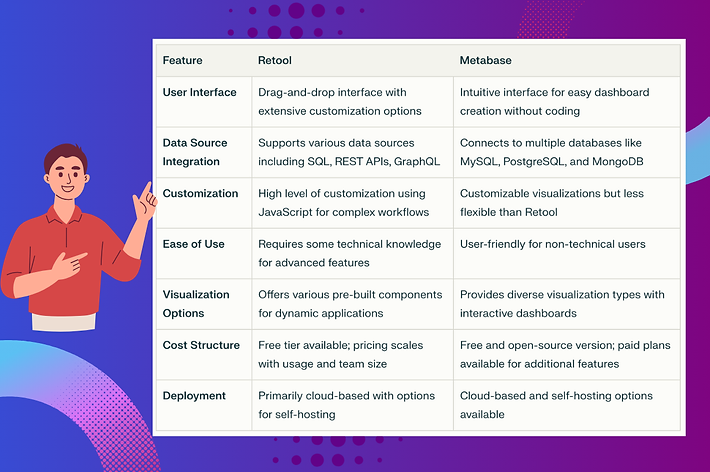
What SaaS gives you:
- Reliability
- Predictability
- Out-of-the-box functionality
- Lower upfront cost
- Little to no maintenance burden
What SaaS takes from you:
- Full control
- Deep customization
- Data model flexibility
- Freedom from vendor lock-in
If your business sits inside standard operational patterns, SaaS becomes a superpower. If your workflows are unique — and many are — SaaS becomes the constraint you spend years working around instead of fixing.
Here’s the real-world contrast:
| Factor | ⚙️ SaaS | 🛠️ Custom (Retool, internal tools) |
|---|---|---|
| Speed to get started | Extremely fast | Medium |
| Workflow flexibility | Low to medium | Extremely high |
| Maintenance | Almost none | Continuous overhead |
| Vendor lock-in risk | High | Low |
| Custom integrations | Often limited | Infinite (if built well) |
| Cost over time | Can balloon | Predictable but depends on engineering |
| Fit for unique workflows | Weak | Strong |
SaaS wins on stability. Custom wins on precision. But precision costs sweat.
The Hidden Cost Founders Underestimate: SaaS-Induced Process Creep
One of the most dangerous parts of SaaS is how it subtly rewires internal processes. Instead of the company shaping tools, the tools shape the company. Sometimes that’s beneficial. Sometimes it’s catastrophic.
Imagine a startup that buys a CRM with a rigid deal structure. Sales adjusts their workflow to match the CRM instead of vice versa. Next quarter, ops is forced to rewrite reporting. Then finance adjusts forecasting logic. Suddenly the whole organization is built around SaaS constraints no one consciously agreed to.
This is the kind of operational debt people never warn you about.
Custom Internal Tools: Freedom With Responsibility Attached
Custom tools give founders something SaaS will never give: ownership. You control every field, every button, every integration, every automation. Tools like Retool, Appsmith, and internal UI frameworks make it surprisingly practical to build dashboards, approval flows, inventory UIs, customer admin panels, and data operations tools in days, not months.
But custom tools come with their own set of risks:
- You own uptime
- You own bugs
- You own permissions logic
- You own documentation
- You own architectural decisions that could haunt you later
Founders often underestimate the operational burden of being a software vendor to their own company. You’re not just building a tool; you’re committing to maintaining it indefinitely.
This is why so many internal tools break: people build with enthusiasm and maintain with reluctance.
The Myth That Retool Replaces Engineers
Retool accelerates engineering; it does not replace it. It makes CRUD apps easy, but complex business logic still needs proper design. The platform provides UI scaffolding and integrations, but the underlying system design — the part that determines whether the tool scales or collapses — must come from someone who understands data architecture, user flows, and operational risk.
Founders who assume Retool gives them “engineering without engineers” inevitably create brittle systems that break under real volume.
The Decision Framework No One Applies (But Should)
Instead of choosing based on emotion or vendor charm, evaluate based on your operating model — not your wishlist.
Ask:
Do our workflows match industry standards or are they inherently unique?
- If standard → SaaS wins
- If unique → Custom tools often win
Do we have reliable internal engineering capacity?
- If yes → Custom becomes viable
- If no → SaaS is safer
Is the workflow mission-critical or peripheral?
- Mission-critical → Avoid SaaS lock-in
- Peripheral → Don’t waste engineering time
Will this workflow evolve significantly in the next 18 months?
- If yes → SaaS will frustrate you
- If no → SaaS will serve you
Here’s the distilled version:
| Condition | 🥇 Best Choice | 🎯 Why |
|---|---|---|
| You need stability and predictable processes | SaaS | Less maintenance, fewer surprises |
| You need deep customization | Custom | Control without vendor constraints |
| You operate in a regulated industry | SaaS or custom (depends on auditability) | Compliance dictates choice |
| You anticipate rapid changes in workflow | Custom | SaaS cannot adapt quickly |
| You lack internal engineering | SaaS | Reality wins over ambition |
| You require proprietary processes for competitive advantage | Custom | Your differentiation shouldn’t be limited by a vendor |
The Real Trap: “We’ll Start With SaaS and Replace It Later”
This is the most expensive lie founders tell themselves.
SaaS becomes the foundation of your business logic before you realize it. The deeper your team embeds your workflows inside SaaS constraints, the harder it becomes to unwind. People justify the switch “later” — but later never arrives because the switching cost compounds quietly.
If the workflow is strategic, do not outsource your core logic to a vendor that cannot adapt with you.
Where Retool Shines (and Where It Doesn’t)
Tools like Retool are phenomenal under the right conditions:
- Internal admin panels
- Moderation dashboards
- Billing review tools
- Partner portals
- Customer support consoles
- Ad-hoc operational workflows
Where Retool struggles:
- Complex, highly polished customer-facing apps
- Systems needing extremely high concurrency
- Workflows requiring deep offline support
- Heavy transactional systems (ERP-grade logic)
Retool’s sweet spot is internal leverage, not external product.
The Hybrid Approach: What Experienced Teams Actually Do
The smartest founders don’t choose build or buy. They orchestrate both. SaaS handles structural needs: CRM, HRIS, accounting, ticketing. Custom tools bridge gaps, enhance workflows, standardize edge cases, and unify data flows.
It’s not build vs buy. It’s build around buy.
A real-world pattern emerges across mature companies:
- SaaS owns the backbone
- Internal tools own the nuance
- Automation ties everything together
- Data teams provide observability
- Engineers maintain core logic, not UI scaffolding
This hybrid model avoids both extremes: rigid SaaS dependency and unbounded internal tool sprawl.
A Reality Check for Founders
Choosing between custom software and SaaS is not a technical decision. It is a strategic decision disguised as a technical one. It affects:
- How fast your team works
- How expensive scaling becomes
- How flexible your workflows remain
- How easily you can pivot
- How resilient your data model is
Founders who underestimate this decision pay for it with operational debt that lingers for years. Founders who understand the tradeoffs build architectures that grow with the company, not against it.
A Final Thought
You’re not choosing software. You’re choosing a future. You’re choosing who controls your workflows — you or a vendor. You’re choosing the limits you’ll accept. You’re choosing whether speed today will cost you adaptability tomorrow.
So here’s the uncomfortable question founders should sit with:
Is your business building on a foundation you control — or one you’ll be trapped inside once growth makes flexibility non-negotiable?