Last Updated on January 8, 2026 by Triumphoid Team
There’s never been a better time to buy software. There’s also never been a better time to drown in it.
Every operational headache seems to have a SaaS logo attached to it now. CRM? There’s a platform. Billing? Another platform. Analytics, HR, project management, marketing automation, procurement – if you mapped your stack, it would probably look like a subway diagram.
At the same time, a lot of serious businesses are quietly realizing something uncomfortable: the more they lean on generic SaaS for core processes, the more they start to look and behave like everyone else. The real competitive edge isn’t in “having tools”; it’s in how those tools are wired into your workflows, data, and decisions.
That’s exactly where outsourcing custom software keeps proving its worth. Not as some old-school “offshore dev” trick, but as a way to get bespoke systems built without turning your company into a software house.
Let’s unpack why, in 2026, outsourcing still often beats “just buy SaaS” and “we’ll build it ourselves,” especially once you zoom out beyond the next quarter.
Build, buy, or outsource: the real choice
Most strategy decks simplify the decision into “custom vs SaaS,” but in reality you’re choosing between three distinct paths for any important system:
You build and maintain it entirely in-house.
You buy SaaS and align your processes to fit it.
You outsource a custom build to specialists and own the result.
Those paths behave very differently once you look at control, time, cost, and risk.
| Option | Control over roadmap | Time to first production use | Long-term cost pattern | Risk profile |
|---|---|---|---|---|
| In-house custom build | Very high, but limited by internal bandwidth | Slow, often 9–24 months for serious systems | High upfront, medium-high ongoing (salaries, overhead) | High delivery risk, heavy dependence on a few key employees |
| Pure SaaS | Low to medium, dictated by vendor roadmap | Fast, from days to a few weeks | Predictable subscription, extra cost for workarounds | Medium risk, vendor lock-in and roadmap dependency |
| Outsourced custom (plus retainer) | High, backed by contract and scope | Medium, often faster than in-house | Medium upfront, flattening change cost over time | Shared risk, easier to change provider than rebuild from scratch |
Outsourcing sits in that interesting third column: you get custom-level flexibility and ownership, but you don’t have to build a full engineering org around every strategic idea.
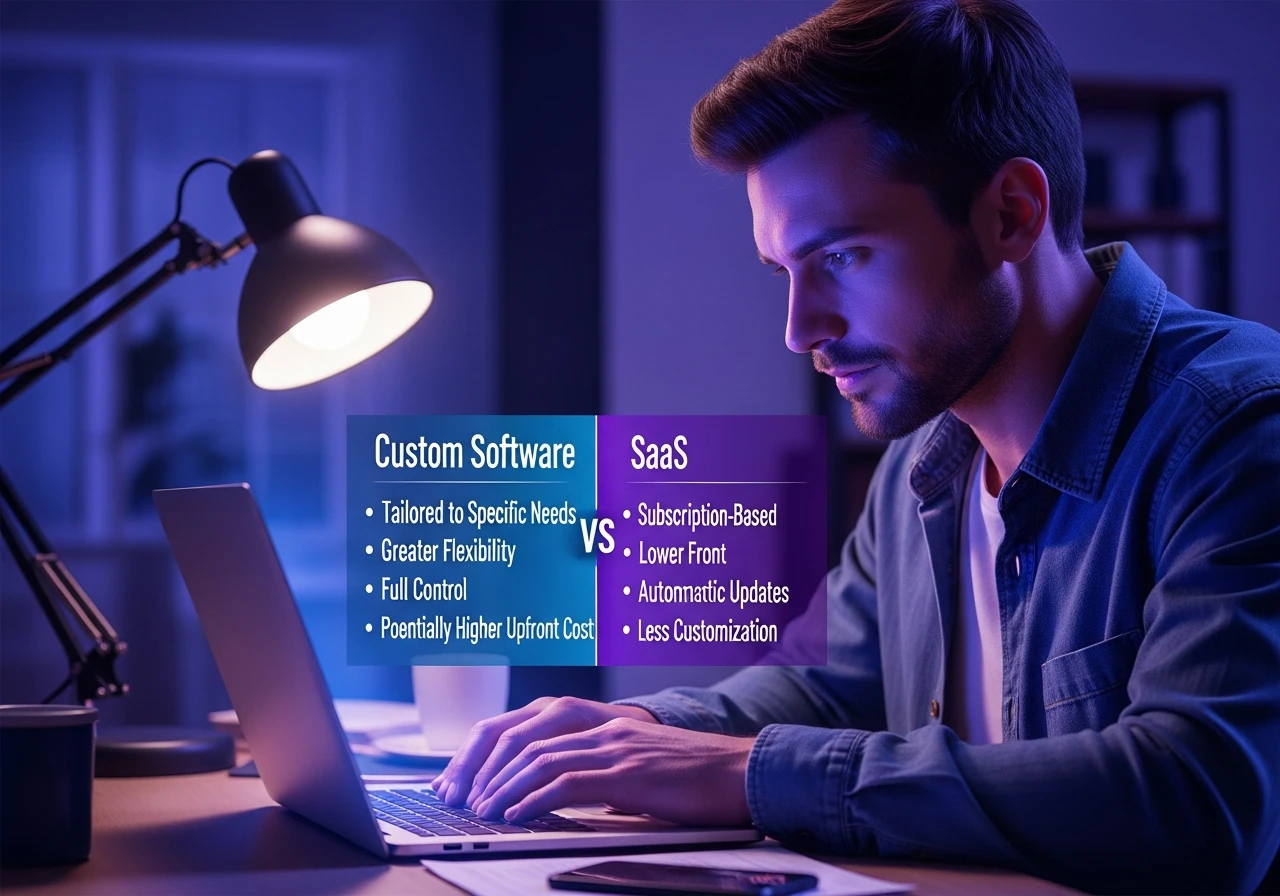
That’s usually where the “200%” shows up: not as some magic margin, but as compounding payoff from having the right tailored systems in place earlier, used daily, and refined over years.
Where SaaS hits a ceiling for growing businesses
SaaS is fantastic for getting from zero to “this works.” If you’re formalizing a process for the first time, launching a new business unit, or standardizing something that was previously chaos in spreadsheets, a good SaaS product is a lifesaver.
Things start to get interesting once you’re no longer average.
- You want to run pricing logic that doesn’t fit the template.
- You want automations that span departments and external partners.
- You want analytics that reflect how your business actually works, not how the vendor thinks it should work.
That’s where the “configurable” SaaS you fell in love with begins to feel more like a cage than a platform.
The pattern is familiar:
Someone asks, “Can we support this new billing model?”
The SaaS answer: “Not directly, but you can approximate it by combining features X, Y, and a manual weekly adjustment.”
Translate that into plain English and it becomes: “Your operations team will pay for the gap with their time.”
Here’s how the strategic ceiling usually looks.
| Aspect | Pure SaaS approach | Custom / outsourced approach |
|---|---|---|
| Unique pricing and discount logic | Limited by settings designed for “most customers” | Defined by your business model and customer segments |
| Workflow across multiple teams | Forced into vendor’s process flows | Designed around how your teams actually work |
| Turning insights into tools | Only if it fits the vendor’s roadmap | Directly embedded into your internal systems and dashboards |
| Data model flexibility | Bound to whatever entities and fields the vendor exposes | Modeled around your own concepts, metrics, and relationships |
SaaS shines when your main requirement is “don’t break, just function.” Once your requirement becomes “help us differentiate,” its rigidity becomes a hidden tax on your ambition.
Why fully in-house builds are more dangerous than they look
The instinctive response to SaaS frustration is, “Fine, we’ll build it ourselves.” On an emotional level, that’s satisfying. On a practical level, it can be brutal.
Serious business systems aren’t just CRUD apps. When you’re dealing with sales pipelines, revenue recognition, compliance steps, supply chains, or customer onboarding, you’re dealing with:
Complex business rules that evolve constantly.
Integrations with other tools, APIs, and sometimes ancient systems you can’t just rip out.
Security, audit trails, access control, regional requirements.
Uptime expectations that don’t care that half your dev team is in hiring limbo.
To do this well in-house, you need more than a couple of good developers. You need:
- Product managers who can translate strategy into tight scopes.
- Engineers who can design systems that won’t collapse under growth.
- DevOps and SRE skills to keep everything running.
- QA that understands both the tech and the business edge cases.
If you have that team and can keep them long term, great. Most companies don’t. They have a handful of key people and a revolving door around them.
What often gets built internally is something that sort of works, but:
- Is under-documented.
- Depends heavily on a few “heroes” who know where all the bodies are buried.
- Becomes risky to touch because everyone fears breaking it.
It’s the classic “internal platform” syndrome: powerful, irreplaceable, and increasingly scary.
Compare internal vs outsourced custom over a few years.
| Factor | In-house custom build | Outsourced custom team |
|---|---|---|
| Speed to MVP | Slower, often dragged by internal priorities | Faster, driven by external delivery discipline |
| Leadership distraction | High; exec and product time sucked into tech debates | Lower; leadership focuses on business outcomes |
| Knowledge concentration | Very high in 1–3 people | Spread across vendor staff plus structured documentation |
| Survivability if people leave | Fragile; some systems become untouchable | Manageable; you can switch providers with the asset in hand |
To be blunt, a lot of “we’ll build it ourselves” stories age into “we now maintain a fragile internal product with no roadmap and no owner.”
Outsourcing doesn’t remove risk, but it shifts some of it away from your own payroll and lets you tap into teams whose entire life is shipping this kind of thing.
Outsourcing as a leverage play, not a budget hack
A lot of people still hear “outsourcing” and think “cheap developers in another time zone.” That’s a very outdated lens.
The real upside in good outsourcing is not cheaper code; it’s faster, sharper translation from business intent to working software.
You’re buying:
Experience from teams that have solved similar problems across multiple clients.
Pre-existing libraries, patterns, and internal tools you’d never see if you hired from scratch.
Delivery discipline that isn’t tangled in your org chart and internal politics.
Take a concrete, non-theoretical example.
Say you want an internal “revenue command center” that pulls in:
- CRM data
- Billing data
- Product usage events
- Marketing spend
You want it to answer questions like:
- Which customer cohorts are truly profitable after discounts and support load?
- Which channels bring in accounts that renew without constant handholding?
- Which salespeople are leaning too heavily on concessions that hurt margin?
You could assemble five different SaaS tools and bounce between dashboards. You could beg your internal BI team to build something… eventually. Or you could scope this as a dedicated product and outsource the build to a team that lives on this type of problem.
Once it’s up and running, that system quietly tunes dozens of decisions every month: pricing, enablement, marketing priorities, sales playbooks. The ROI compound is not in the “software cost.” It’s in every decision that gets 2–3 percent smarter because the right data is finally in one place.
Here’s how outcomes usually differ.
| Approach | Typical state after 3 years |
|---|---|
| SaaS patchwork | Multiple dashboards, manual reconciliation, blind spots |
| In-house “side project” | Internal tool that works, but is clunky and rarely improved |
| Outsourced custom | Stable internal product with versions, roadmap, and clear owner |
That “200%” payoff isn’t hype. It’s the gap between a tool you occasionally tolerate and a system you actually run the business on.
Total cost of ownership: the long view
On a one-year budget, SaaS almost always looks cheaper and friendlier. You sign, you pay per seat or per usage unit, and you get value quickly. Custom projects – especially outsourced ones – can look heavy at the start.
The equation flips when you zoom out to three or five years and factor in:
- Workarounds and manual processes created to compensate for SaaS limitations.
- The cost of switching tools when a vendor stops fitting your size or strategy.
- Opportunities missed because certain ideas were “not supported by the platform.”
Let’s keep it directional and simple.
| Time horizon | Pure SaaS stack (subs + internal glue) | Outsourced custom (build + evolution) |
|---|---|---|
| Year 1 | Medium subscription, high internal adaptation load | Higher project cost, lower daily friction |
| Year 2 | Growing sub costs, more hacks and scripts | Moderate change cost, system fits the business better |
| Year 3+ | Subscription plus hidden labor cost growing | Mostly incremental improvements and maintenance |
| Big-picture ROI | Looks cheaper early, value flattens or erodes | Higher upfront, payback grows as the system compounds |
Truth be told, neither path is free of surprises. Projects can slip, vendors can underdeliver, priorities can shift. But as long as the outsourced build is focused on a real leverage point – something that meaningfully shapes revenue, margin, or risk – the investment tends to age well.
The trap is comparing “SaaS per month” to “custom project cost” without including the human time you’re spending making generic tools behave like they were built for you.
Managing risk: vendor lock-in vs asset lock-in
Everyone worries about vendor lock-in with SaaS, and that worry is valid. Exporting data is rarely as smooth as sales promised. Rebuilding workflows in a new product hurts. You feel stuck.
What gets less air time is “asset lock-in” when you build everything yourself. You can get trapped inside your own architecture and your own backlog. The system becomes too big, too messy, and too entangled with everything else to modernize easily.
Outsourcing, done right, sits in the middle. You do depend on a partner, but:
The code and architecture can be yours by contract.
Documentation and handover can be enforced as part of milestones.
You can re-tender maintenance or feature work to another vendor if needed.
Risk looks different across the three paths.
| Risk type | SaaS-heavy approach | In-house only | Outsourced custom |
|---|---|---|---|
| Vendor shuts down | You scramble to migrate with whatever export exists | Less relevant | You still own the codebase and can self-host |
| Key people leaving | Mostly vendor’s problem, unless service degrades | Your problem; critical institutional knowledge gone | Vendor risk, but you can rotate suppliers |
| Tech stack aging | Tied to vendor’s modernization schedule | Requires large internal modernization project | Can be upgraded incrementally with external help |
No path gives you zero risk. The question is simply: which risk are you better equipped to manage?
Personally, I’d rather manage a portfolio of external partners around assets we own than be held hostage by one monolithic SaaS provider or a creaking internal system nobody wants to touch.
How to make outsourcing actually work
Outsourcing fails when it’s treated as “throw a PDF of requirements at some agency and hope they send magic back.” That rarely ends well.
It works when you treat it like an extension of your product function.
The projects that consistently deliver in my experience look like this:
There is a sharp internal owner. Not a vague “steering committee,” but one person who actually cares about the outcome and can make decisions.
The vendor is chosen for domain experience, not just generic code skills. If you’re building logistics tooling, pick people who have touched logistics. If you’re building a finance workflow, pick folks who understand ledgers and controls. Tech stacks are negotiable; domain blindness is not.
The scope is sliced into meaningful phases. First you get the core workflow or insight in place. Then you add advanced automation, fancy UI, and nice-to-haves. That structure lets you get value early and avoid the “two-year mega project” trap.
The relationship is ongoing. A small, predictable retainer for updates beats a huge up-front build followed by abandonment. Software that matters rarely stands still.
You’re not outsourcing responsibility; you’re outsourcing execution capacity under your direction. Big difference.
Where SaaS still makes absolute sense
To keep this honest: there are places where I wouldn’t consider custom or outsourcing, at least not initially.
If a function is:
Highly standardized across industries,
Low strategic differentiation for you,
And already well served by mature products,
then just buy the SaaS and move on.
Think basic HR systems, commodity ticketing, generic time tracking, standard email services. Your advantage doesn’t come from having a custom PTO approval interface. It comes from the systems that shape customers, revenue, and internal decision-making.
My rule of thumb is simple: if this part of the stack defines how we create or capture value, it’s a candidate for custom. If it just needs to function quietly, SaaS is fine.
The real question for 2026
We’re in an era where it’s incredibly easy to subscribe to software and incredibly hard to build something truly unique. Most companies do the first and tell themselves stories about the second.
Outsourcing custom software development isn’t about rejecting SaaS or pretending you’re a tech company. It’s about being honest about where you need to be different and then getting serious help turning that into working systems.
So the question isn’t “SaaS or custom?” anymore. The more useful question is:
Which parts of your business deserve tools that exist only because your business exists – and what’s your plan for getting those built before your competitors wake up and do the same?