Automated Internal Linking in WordPress via API

Last Updated on September 13, 2026 by Triumphoid Team
⚡ TL;DR
The clean way to do automated internal linking wordpress is not to install a bloated plugin that sprays links across your archive like confetti. The better approach is a small script or workflow that reads your site architecture from the WordPress REST API, builds a lightweight map of important pages and topics, asks an LLM to suggest or choose semantically relevant internal link targets, and then inserts those links into post content only when the match is contextually strong. WordPress already supports reading and updating posts through REST, and tools like n8n’s HTTP Request node are perfectly capable of orchestrating the whole flow without a heavy plugin. In plain English: read architecture → score relevance → suggest or insert links → update the post. That gives you internal linking that behaves more like editorial judgment and less like SEO vandalism.
Most internal linking plugins have the same personality flaw: they are overeager.
They see a keyword, they see an old URL, and they get excited. Suddenly your article reads like it was written by a caffeinated anchor-text intern. That is why I think this topic matters so much. Internal linking is not just a mechanical SEO task. It is information architecture, crawl-path shaping, topical reinforcement, and user guidance. Treat it like a dumb find-and-replace problem and you get dumb results.
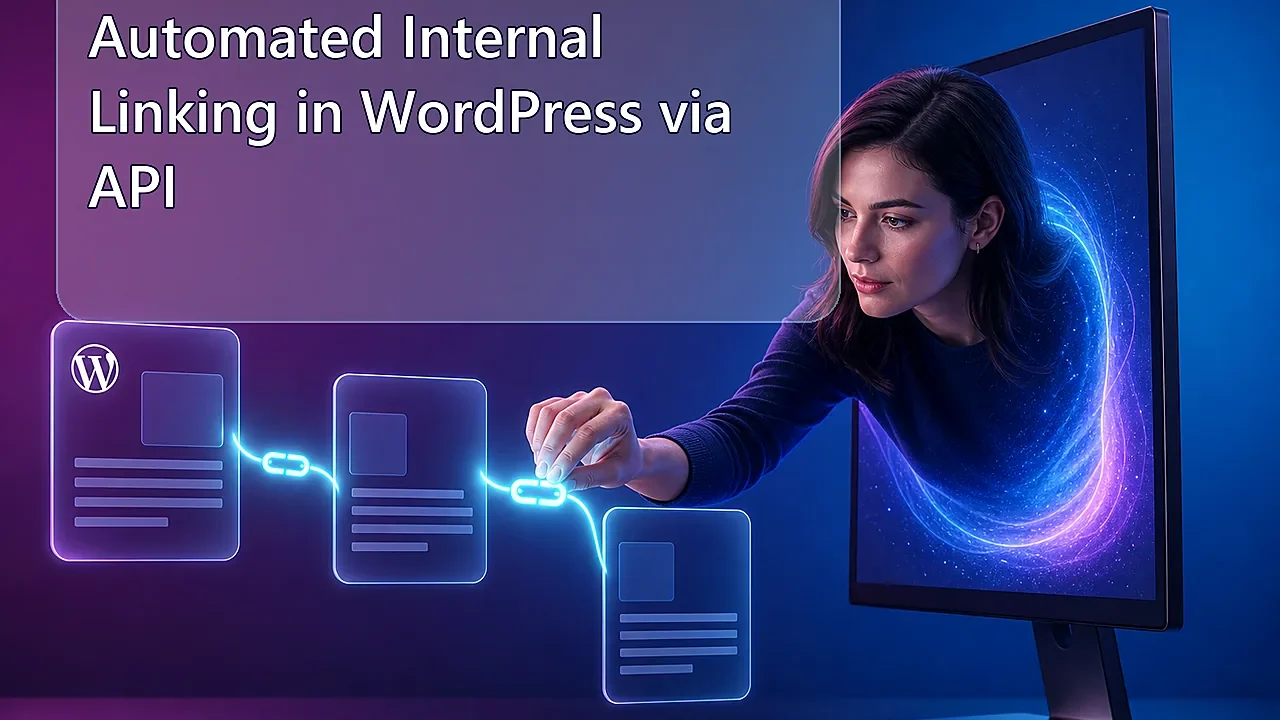
The better approach is lighter and stricter. Read the site structure. Understand which pages are topically close. Suggest or insert only the links that make sense in the actual sentence. Then write the updated content back into WordPress through the API. That is a real automation workflow, not a plugin-shaped compromise. WordPress exposes predictable REST endpoints for posts and categories, which is exactly what makes this kind of external linking logic feasible without stuffing more code into your theme. :contentReference[oaicite:1]{index=1}
What automated internal linking wordpress actually means
Automated internal linking wordpress means using code or workflows to analyze your site’s structure and content, identify relevant target pages, and either suggest or insert contextual internal links into posts automatically. In a clean implementation, the system reads posts from WordPress, builds a structured map of URLs and topics, asks a model or rule engine to choose relevant targets, and then updates the content back through the post endpoint.
The important word there is contextual. We are not trying to shove links anywhere a keyword appears. We are trying to place a link where a human editor would reasonably want one.
The short framework
| Step | What the workflow does | Why it matters |
|---|---|---|
| 1 | Reads the site architecture | Builds a real map of available internal targets |
| 2 | Extracts post content and topic signals | Understands the actual linking context |
| 3 | Matches candidate URLs semantically | Avoids crude keyword-only linking |
| 4 | Suggests or inserts links into specific sentences | Keeps the output editorially natural |
| 5 | Writes the revised post back to WordPress | Turns the analysis into a real CMS update |
The market opinion is that internal-link automation needs a plugin because WordPress “already lives in WordPress.” I think that is backwards. This is exactly the kind of job that works better as an external workflow, because external logic can stay lean, inspectable, and much easier to control.
Why a script beats a heavy plugin here
Because a plugin tends to live inside your runtime and behave like it owns the place. A script behaves like a contractor. It comes in, does the job, leaves, and does not insist on adding a new admin submenu, five extra settings pages, and a mystery table in your database.
WordPress already gives you the pieces you need: the posts endpoint for reading and updating content, the categories endpoint for topology hints, and extensibility paths like register_meta() and register_rest_field() if you want to expose extra relevance metadata to your workflow. That is already a strong base layer. :contentReference[oaicite:2]{index=2}
How to read site architecture without a plugin
This is where people usually overcomplicate things.
You do not need a mythical “site architecture API.” In most cases, your architecture can be approximated perfectly well from WordPress itself: post titles, slugs, categories, excerpts, and optionally a custom field that marks pillar pages or priority URLs. The REST API can already return collections of posts and categories, so your script can build a lightweight site graph from existing content objects. :contentReference[oaicite:3]{index=3}
A practical architecture map might include:
| Field | Why it belongs in the map | How it helps linking |
|---|---|---|
| Post ID | Stable internal key | Keeps updates and exclusions deterministic |
| Slug / permalink | Actual target URL | Used for link insertion |
| Title | Primary topic clue | Helps identify topical fit |
| Excerpt | Short semantic summary | Improves matching beyond raw title words |
| Categories | High-level topical grouping | Useful first-pass relevance filter |
| Pillar / priority flag | Business importance hint | Lets the workflow prefer strategic URLs |
That is enough to build a respectable internal-linking brain without dragging a heavyweight plugin into the site.
The right linking logic
The good version is two-stage.
Stage one is deterministic filtering. Remove the current URL, remove obviously unrelated categories, remove already-linked targets, remove thin or low-priority pages, and maybe prefer pillar pages or commercially important URLs. Stage two is semantic judgment. That is where the script or model chooses the best targets for actual insertion.
This matters because LLMs should not be used as your only filter. That is lazy architecture. The deterministic layer should narrow the choice set first. Then the model can do the expensive part: reading the sentence and deciding whether a link would feel natural there.
Structured AI outputs make this safer
If you let the model answer in free text, it will eventually do something annoying. It will explain itself, add extra commentary, pick the wrong format, or return beautifully phrased nonsense. That is why Structured Outputs matter here. They let you force the model into a strict JSON schema, which is exactly what you want when the output needs to be machine-safe rather than charming. :contentReference[oaicite:4]{index=4}
The model should return something like:
{
  "suggestions": [
    {
      "target_post_id": 431,
      "target_url": "https://example.com/wordpress-rest-api-guide/",
      "anchor_text": "WordPress REST API guide",
      "source_sentence": "For direct API-based media automation, WordPress already gives you the endpoints you need."
    }
  ]
}
That is the right output shape. Boring. Structured. Hard to misunderstand. Perfect.
Python script: read architecture and suggest contextual internal links
This script reads posts from WordPress, builds a minimal architecture map, sends the current post and candidate targets to an LLM with a strict schema, then returns contextual internal-link suggestions. It does not blindly insert every possible link, because that would be stupid. It gives you one clean layer of judgment first.
import os
import json
import requests
from openai import OpenAI

WP_URL = os.environ["WP_URL"].rstrip("/")
WP_USERNAME = os.environ["WP_USERNAME"]
WP_APP_PASSWORD = os.environ["WP_APP_PASSWORD"]
OPENAI_API_KEY = os.environ["OPENAI_API_KEY"]

POST_ID = 123  # Change this

client = OpenAI(api_key=OPENAI_API_KEY)

def wp_auth():
    return (WP_USERNAME, WP_APP_PASSWORD)

def get_posts():
    r = requests.get(
        f"{WP_URL}/wp-json/wp/v2/posts",
        auth=wp_auth(),
        params={"per_page": 100, "status": "publish"}
    )
    r.raise_for_status()
    return r.json()

def get_post(post_id):
    r = requests.get(
        f"{WP_URL}/wp-json/wp/v2/posts/{post_id}",
        auth=wp_auth()
    )
    r.raise_for_status()
    return r.json()

def build_candidate_map(posts, current_post_id):
    candidates = []
    for post in posts:
        if post["id"] == current_post_id:
            continue

        candidates.append({
            "id": post["id"],
            "title": post["title"]["rendered"],
            "excerpt": post["excerpt"]["rendered"],
            "url": post["link"],
            "categories": post.get("categories", [])
        })
    return candidates

def suggest_links(current_post, candidates):
    prompt = f"""
You are an internal linking assistant for WordPress.

Task:
Choose up to 3 contextual internal links for the source article.

Rules:
- Only use targets from the allowed candidate list.
- Choose links that are semantically relevant, not just keyword matches.
- Do not suggest the current post.
- Do not force a link if relevance is weak.
- Return valid JSON only.

Source article title:
{current_post["title"]["rendered"]}

Source article content:
{current_post["content"]["rendered"]}

Allowed candidate targets:
{json.dumps(candidates, ensure_ascii=False)}
"""

    response = client.responses.create(
        model="gpt-5.4-mini",
        input=prompt,
        text={
            "format": {
                "type": "json_schema",
                "name": "internal_link_suggestions",
                "schema": {
                    "type": "object",
                    "properties": {
                        "suggestions": {
                            "type": "array",
                            "items": {
                                "type": "object",
                                "properties": {
                                    "target_post_id": {"type": "integer"},
                                    "target_url": {"type": "string"},
                                    "anchor_text": {"type": "string"},
                                    "source_sentence": {"type": "string"}
                                },
                                "required": [
                                    "target_post_id",
                                    "target_url",
                                    "anchor_text",
                                    "source_sentence"
                                ],
                                "additionalProperties": False
                            }
                        }
                    },
                    "required": ["suggestions"],
                    "additionalProperties": False
                }
            }
        }
    )

    return json.loads(response.output_text)

def main():
    all_posts = get_posts()
    current_post = get_post(POST_ID)
    candidates = build_candidate_map(all_posts, POST_ID)
    suggestions = suggest_links(current_post, candidates)

    print(json.dumps(suggestions, indent=2, ensure_ascii=False))

if __name__ == "__main__":
    main()
This version is safe because it constrains the model’s universe. It cannot invent random targets from your domain. It can only choose from the candidates you handed it. That is exactly how these systems should behave.
How to insert links automatically without wrecking the prose
This is where most people get cocky and ruin the article.
The clean rule is simple: only insert a link when the source_sentence actually exists in the post and the chosen anchor text fits naturally inside it. Then replace just the first suitable anchor occurrence inside that sentence, not every matching phrase across the whole article. That keeps the output looking like an editor touched it rather than an SEO plugin with boundary issues.
Once the updated HTML is ready, WordPress can accept the new content through the posts endpoint, because the REST API supports updating post content directly. :contentReference[oaicite:5]{index=5}
Python example: insert the links and update WordPress
def insert_link_once(html, sentence, anchor_text, target_url):
    if sentence not in html:
        return html

    linked_anchor = f'<a href="{target_url}">{anchor_text}</a>'

    sentence_with_link = sentence.replace(anchor_text, linked_anchor, 1)

    return html.replace(sentence, sentence_with_link, 1)

def update_post_content(post_id, new_html):
    payload = {
        "content": new_html
    }

    r = requests.post(
        f"{WP_URL}/wp-json/wp/v2/posts/{post_id}",
        auth=wp_auth(),
        json=payload
    )
    r.raise_for_status()
    return r.json()

def apply_suggestions(current_post, suggestions):
    html = current_post["content"]["rendered"]

    for item in suggestions["suggestions"]:
        html = insert_link_once(
            html,
            item["source_sentence"],
            item["anchor_text"],
            item["target_url"]
        )

    return html
That is the kind of insertion logic I trust. Small. Explicit. Easy to audit. No hidden plugin heuristics mutating half the article because one keyword appeared seven times.
n8n version of the same idea
If you want to orchestrate this without wrapping everything into one Python script, n8n is a good fit because its HTTP Request node can read and update WordPress via REST, and its workflow logic is better than most people’s improvised cron spaghetti. The basic sequence is:
| Node | Job | Why it belongs |
|---|---|---|
| Schedule Trigger | Runs daily or on demand | Keeps the linking workflow controlled |
| HTTP Request | Reads WordPress posts | Builds the architecture and source content set |
| Code / Set | Filters candidate URLs | Reduces model noise |
| LLM node | Returns structured suggestions | Handles semantic judgment |
| Code node | Inserts links carefully into HTML | Keeps formatting deterministic |
| HTTP Request | Writes updated content back | Makes the change real in WordPress |
That is one of those rare cases where an external workflow engine is better than a plugin because the logic wants to live outside the editorial runtime.
What docs do not tell you
Keyword matching is not semantic linking. A lot of “internal linking automation” advice is really just anchor detection with delusions of grandeur. It does not understand whether the target page is actually the right next click.
The site architecture matters more than the model. If your taxonomy is messy, your pillar pages are unclear, and your archive is full of near-duplicate topics, the model will not magically fix your linking strategy. It will just operate inside your disorder.
Insertion logic is riskier than suggestion logic. Suggesting links is easy. Inserting them without damaging tone, HTML structure, or editorial credibility is where real systems thinking starts.
REST field extension can make this much better. If you want the workflow to understand page importance, freshness, or pillar status, exposing those fields via register_meta() or register_rest_field() is often cleaner than teaching the model to guess business priorities from titles alone. :contentReference[oaicite:6]{index=6}
🛠 Pro-Tip
Store a small custom REST field like internal_link_priority or pillar_score on your most strategic pages and expose it through WordPress REST. Then let the workflow use that field as a ranking signal before the LLM ever sees the candidates. That one extra feature turns internal-link automation from “interesting” into “aligned with business intent.”
Our experience with automated internal linking wordpress
Our experience with automated internal linking wordpress is that the biggest mistake is assuming more links automatically means better internal linking. It does not. A bad internal link is not neutral. It distracts the reader, muddies topical signals, and makes the content feel engineered rather than useful.
The workflows that work best are actually pretty restrained. They prefer a few high-confidence links over a lot of mediocre ones. They know which URLs matter commercially or architecturally. They insert links where the sentence is already inviting the click, not where some keyword matcher got overeager. In other words, they behave more like a careful editor than a plugin trying to justify its license fee.
And honestly, that is the real question here: if your current internal linking process still depends on either manual drudgery or a heavyweight plugin spraying anchors everywhere, are you really optimizing site architecture, or are you just automating clutter with slightly better intentions?