Activepieces vs. n8n: Open Source Automation Comparison
Comparative review evaluating open-source automation stacks on security boundaries, custom component design libraries, and internal self-hosting configurations.

Last Updated on September 13, 2026 by Triumphoid Team
Executive Briefing
- open source automation platforms is an operating design question, not only a product comparison.
- Start with observable inputs, explicit decision rules, and a named owner for exceptions.
- Use illustrative numbers to test the model, not to imply a company benchmark.
- Keep evidence with the outcome so operators can explain and improve the workflow.
When teams search for open source automation platforms, they are usually trying to answer a practical question: what should we build, buy, or change first? We use that question as the starting point. The useful answer is a control loop that makes work observable, keeps decisions explainable, and gives an operator a safe recovery path when the happy path breaks.
B2B teams usually discover this problem after the first workflow becomes important. A demo can tolerate manual correction; a production process cannot. The design question is how to keep each run visible, reversible, and owned.
open source automation platforms: the practical definition
Key Definition: open source automation platforms is the set of technical and operating choices that turns a recurring business signal into a controlled, reviewable outcome.
That definition matters because most automation discussions stop at the connector or model. In production, the connector is only one part of the system. We also need an input contract, a decision boundary, a failure policy, an audit trail, and a clear handoff when the system cannot decide safely. Those pieces determine whether a workflow remains useful after the first successful demonstration.
How we approach open source automation platforms
Our preferred approach is technical deep dive. We map the path from trigger to outcome, then ask where state can be lost, duplicated, delayed, or misinterpreted. A small workflow can often use a single queue and a compact log. A more important workflow needs idempotency keys, explicit retries, rate-aware scheduling, and a review surface that lets a person intervene without editing production code.
A reliable design makes the normal path boring. Events arrive in a known shape, the system records the relevant context, and the next action follows a policy that an operator can inspect. That clarity is more valuable than adding another connector simply because it is available.
| Condition | Design response | Evidence |
|---|---|---|
| Normal path | Validate input, apply named policy, continue | Outcome and timestamp are visible |
| Boundary case | Pause or route to a review queue | Reason and owner are recorded |
| Failure path | Bound retries, alert, and preserve context | Recovery can be reproduced |
| Change event | Version the contract and test the fallback | Old and new behavior are comparable |
Reference implementation pattern
The following data shape is intentionally small. It keeps the decision visible to the next node or service instead of burying the reason inside a long prompt, a mapper, or a database trigger. In our platform work, this makes review faster because an operator can see what arrived, which policy ran, and what the system decided.
const decision = {\n topic: "open source automation platforms",\n owner: "named operator",\n policy: "allow | review | stop",\n evidence: ["input", "rule", "outcome"]\n};Build the first version with a dry-run mode. Send the event through observation and decision steps, but route the final action to a review queue. Once the queue shows stable classifications, promote only the low-risk branch to automatic execution. This staged rollout is easier to reverse than a full launch followed by a cleanup project.

Where production implementations fail
A system that works only when every dependency behaves perfectly is not resilient; it is merely lucky. Test slow responses, malformed payloads, duplicate events, expired credentials, and changes in upstream field names before calling the workflow production-ready.
- Ambiguous ownership: an alert exists, but nobody is accountable for the next action.
- Hidden state: a spreadsheet, cache, or manual note contains context that the next operator cannot see.
- Unsafe fallback: a timeout is treated as approval instead of moving the item to review.
- Weak evidence: the system records only “failed,” so the team cannot reproduce the decision.
Implementation note: define the stop condition before defining the happy path. A workflow that pauses safely is more valuable than one that completes quickly but cannot explain an incorrect outcome.
Illustrative operating example
Assume a team receives 100 events in a workday and expects 8 of them to need human review. If the first implementation sends every event to a high-cost action, the expensive branch becomes the default. A better design observes all 100, applies a deterministic screen, and routes only uncertain cases to review. The figures are illustrative rather than a benchmark; they make the trade-off easy to test.
A useful planning formula is expected effort = event volume × review rate × average review minutes. With 100 events, an illustrative 8% review rate, and 6 minutes per review, the queue represents 48 minutes of work. If the review rate doubles, the design should expose that change instead of quietly increasing backlog.
Implementation checklist for open source automation platforms
- Write the input contract and list fields that are required, optional, or rejected.
- Give every decision a policy name, an owner, and a reason that can be logged.
- Add idempotency or deduplication before any irreversible action.
- Make retries bounded and distinguish transient errors from bad inputs.
- Store enough evidence to replay a representative success and failure.
- Test the slow path, empty path, duplicate path, and human-review path.
- Document how to rotate credentials, pause the workflow, and roll back the last change.
Operational edge cases worth testing
The most useful review is a replay, not a meeting. Pick one successful run, one slow run, one duplicate, and one rejected input. For each, ask whether the log contains the same context an operator would need during an incident. If not, improve the evidence before adding more automation. This discipline keeps the workflow legible as integrations and policies accumulate.
Before launch, write three review questions: what would make us stop this workflow, who can approve a manual override, and how will we know that a failure is becoming common? These questions turn vague ownership into an operating agreement. They also give the team a short agenda for the first post-launch review.
For a final pre-launch check, compare the workflow against the business outcome rather than the canvas alone. If an operator cannot tell why the system stopped, what it changed, or what should happen next, the design still needs another pass.
Questions for the first review
- Which assumptions are verified, and which are only illustrative?
- Can a person recover safely without changing production logic?
- Does the evidence explain both the decision and the outcome?
The operating owner should also define a simple success signal and a guardrail. A success signal might be completed work or reduced handling time; a guardrail might be duplicate creation, unresolved queue age, or an unsafe external action. Watching both prevents a workflow from looking efficient while quietly creating a larger downstream problem.
Keep the system useful after launch
The practical next step is to choose one narrow path, instrument it, and give an operator a safe way to intervene. Once the evidence is clear, expand the workflow one boundary at a time.
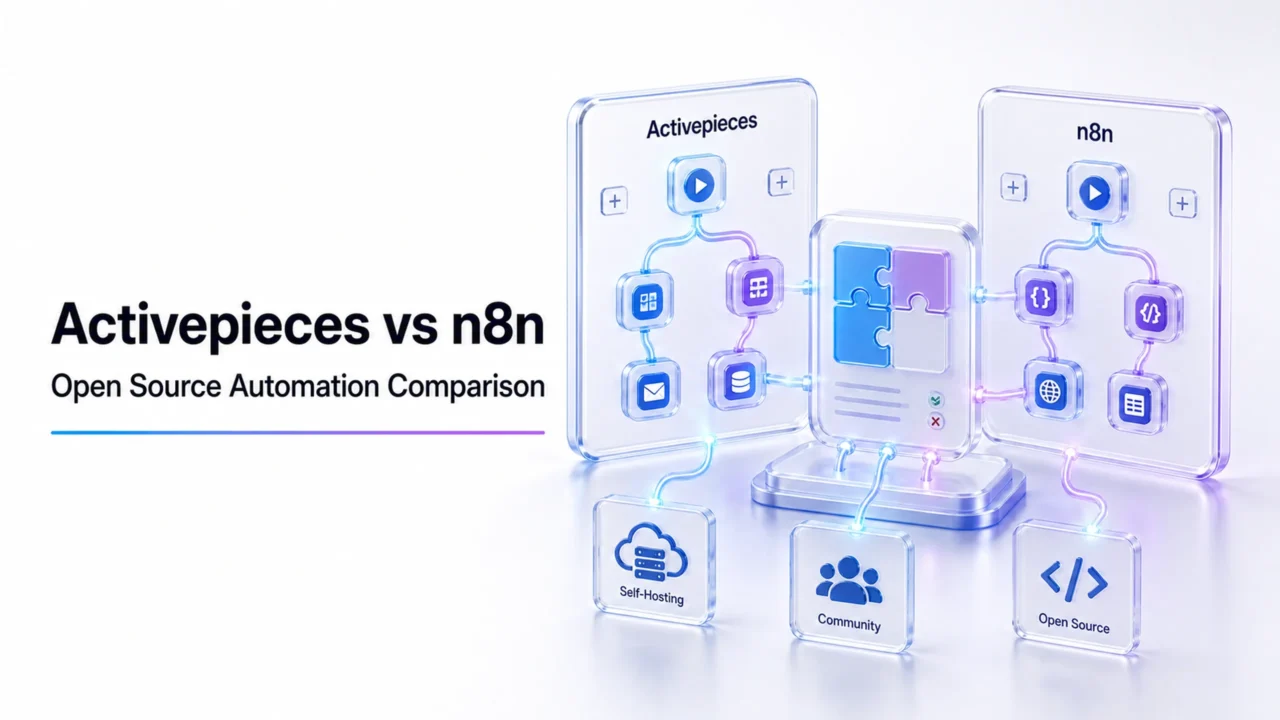
Open-source automation platforms such as Activepieces and n8n let teams self-host their entire workflow engine, trading the convenience of a managed SaaS platform for full control over security boundaries, custom component libraries, and infrastructure cost. This article compares the two directly on their security models, extensibility for building custom nodes, and the operational overhead of running each in a self-hosted configuration. It’s part of the Zapier vs. Make vs. n8n pillar cluster.
For related workflow design guidance, see:
Explore Triumphoid for more practical guidance on AI-powered workflow automation.