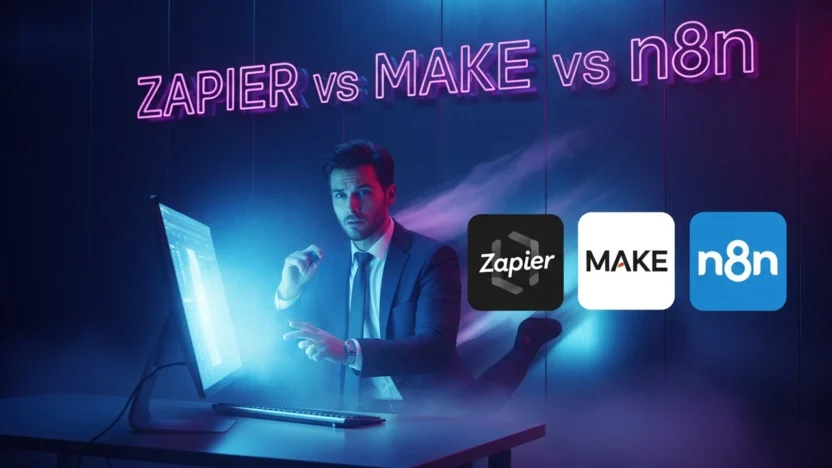
If you want the non-romantic answer: Zapier is the fastest way to get value when automation is “supporting cast.” Make is the best visual “systems diagram” when you’re doing real routing and data shaping. n8n is what you pick when automation becomes infrastructure and you’re done paying per micro-step.
The billing units tell the story: Zapier charges per successful action (“task”), Make charges per module action (“credit”), n8n Cloud charges per end-to-end run (“execution”). Those choices become either a rounding error—or a profit leak—once agentic workflows start multiplying calls, retries, and JSON cleanup.
Now the part the snippet won’t tell you: the “best” platform depends less on features and more on how much operational ownership you can stomach. Every stack eventually hits the same ugly constraints: OAuth token refresh weirdness, webhook bursts, rate limits, partial writes across systems, and the delightful moment someone asks why a workflow ran 12,000 times overnight.
Let’s do the comparison like adults!
Head-to-head: what you’re really buying?
| Dimension | Zapier | Make | n8n |
|---|---|---|---|
| Core philosophy | Convenience-first automation | Visual workflow engineering | Workflow as infrastructure |
| Billing unit | Tasks (successful actions) | Credits (module actions; generally 1 per module action) | Executions (one full run, unlimited steps) |
| Scaling behavior | Costs rise with step count + retries; overages can kick in at 1.25× and hard-stop at a maximum usage cap | Costs rise with module actions; extra credits cost more than in-plan credits | Costs rise with run frequency, not complexity; self-host shifts cost to ops work |
| Best at | Fast wins across SaaS apps | Complex branching/routing and data shaping in a visual graph | High-volume, complex logic, data control, custom endpoints |
| Worst at | Long, dense workflows that “breathe” a lot | Teams who don’t think in flowcharts | Teams with no appetite for governance/ownership |
| Lock-in risk | High (logic lives in Zap UI) | Medium (scenarios exportable; still platform-specific) | Lower if self-host + version control discipline |
| Debugging posture | Friendly, but step-by-step billing punishes defensive design | Strong observability feel for visual thinkers | Best when you treat it like engineering (logs, retries, versioning) |
| Who feels at home | Ops teams who want it to “just work” | RevOps + builders who love seeing every gear | Technical teams who accept that plumbing exists |
I’m not calling any of them “bad.” I’m saying they each punish a different kind of naïveté.
Pricing models in 2026: the cheat sheet
Here’s the trap: most “pricing breakdowns” compare plan stickers. That’s the least interesting number. The real number is unit cost × volume × failure rate.
How each platform meters work
| Platform | Meter | What inflates it | Why it sneaks up on you |
|---|---|---|---|
| Zapier | Tasks | More actions, more retries, more “safety steps” | A workflow that grows from 6 actions to 40 actions doesn’t feel 6× bigger—until Finance sees it |
| Make | Credits | More module actions; some AI/token-based features can vary | It’s easy to build “one more router” and forget you just doubled work |
| n8n Cloud | Executions | More end-to-end runs | A complex workflow is still one execution, which is either relief… or a reason to run it everywhere |
| n8n self-host | Infra + time | Uptime, monitoring, upgrades, backups, incident response | You stop paying per step and start paying for adulthood |
Concrete reference points (official numbers)
- Zapier counts tasks as successful actions.
- Zapier pay-per-task overages are billed at 1.25× the plan’s task cost, and there’s a maximum usage cap where Zaps can stop running.
- Make bills in credits; each module action in a scenario counts as one credit (with exceptions described in their docs).
- Make’s official API rate limits scale by plan (Core 60/min, Pro 120/min, Teams 240/min, Enterprise 1000/min).
- n8n Cloud prices by monthly workflow executions regardless of complexity, and lists plan tiers (Starter 2.5K executions, Pro 10K, etc.).
That’s the raw math. Now let’s do the part everyone avoids: scaling.
Workflow automation comparison that doesn’t lie:
Here are 3 real scaling scenarios:
Below are scenarios I keep seeing in B2B stacks in 2026. Not “toy Zaps.” Real ones. With edge cases and human consequences.
Scenario 1: Marketing ops “lead hydration” with an AI layer
A new inbound lead hits HubSpot. You enrich the company, classify intent, route to the right segment, notify sales, and write a record to the warehouse for attribution.
In 2022, this was 5–10 steps. In 2026, “agentic enrichment” turns it into a chain: multiple API endpoints, retries when vendors throttle, JSON data transformation, dedupe logic, and logging because someone got burned once and refuses to be burned twice.
Who wins here
- Zapier wins if the volume is low and you’re allergic to ownership.
- Make wins if you need a visible routing graph (routers/filters) and you’re constantly tweaking logic.
- n8n wins if this runs at volume and you’re done paying for every tiny transformation.
The cynic’s detail: most teams don’t notice they’re building a metered utility bill until the AI layer starts calling tools like it’s free.
Scenario 2: RevOps “deal stage synchronization” with loops, retries, and guardrails
This is where things get expensive in a way that feels unfair.
You sync deal stages between CRM, internal tracker, and finance system. You add a “safety” step to prevent duplicates. Then a second safety step because the first one didn’t catch a weird edge case. Then you add replay logic for failed runs. Then you add alerting when rate limits hit. Then you add a dead-letter queue equivalent because partial writes are poison.
You didn’t build “one workflow.” You built a mini distributed system. Congratulations.
What breaks first
- OAuth authentication refresh during a burst of updates.
- Webhook listeners receiving duplicates (retries/timeouts).
- Rate limits returning 429s and triggering retries.
- JSON payloads changing shape because one app renamed a custom field.
This is where n8n starts looking less like a “tool” and more like a decision to take control.
Scenario 3: Support + product telemetry with webhook bursts
Product events arrive in bursts. Your webhook listeners get hit hard. If you do the naive thing, you stampede your downstream systems and then “mysteriously” hit limits.
Zapier can handle scale too, but billing per successful action makes defensive design feel like you’re being charged for doing the responsible thing.
If your telemetry volume is high, n8n’s execution-based pricing (Cloud) or self-hosting becomes attractive because the workflow can do more without turning into a per-step cash register.
“Pricing breakdown” with numbers that matter: 1-year TCO patterns
I’m not going to invent your exact bill. Your stack has its own personality disorders. But we can model Total Cost of Ownership in a way that actually predicts pain.
Assumptions (simple, realistic)
- Higher volume increases retries and recovery work.
- AI/agentic workflows increase step count and tool calls.
- “Doing it right” adds steps (logging, idempotency, reconciliation).
One-year TCO comparison table (scaling debt included)
| Workload profile | Zapier 1-year TCO shape | Make 1-year TCO shape | n8n Cloud 1-year TCO shape | n8n self-host 1-year TCO shape |
|---|---|---|---|---|
| <10k unit/month, stable workflows | Usually tolerable; minimal ownership | Usually tolerable; very buildable | Often overkill unless you want “runs not steps” | Likely not worth the ops time |
| 100k unit/month, branching + retries | Can get ugly fast; pay-per-task overages at 1.25× are common when you mis-estimate | Predictable if you track credits honestly; extra credits cost more than in-plan credits | Predictable if “executions” map cleanly to business events | Cheap infra, expensive responsibility |
| 1M unit/month, webhook bursts + AI | Billing becomes strategic risk; max usage caps can pause critical automations | Feasible, but you need credit discipline + rate limiting | Feels designed for this if you budget executions | Infra + reliability engineering becomes the real line item |
If you’re thinking “this still feels fuzzy,” good. It means you’re not falling for sticker-price theater.
Technical hell: what breaks when your workflows become real
You can’t “no-code” your way out of physics. Here’s the table I wish more B2B teams printed and taped to the wall.
| Failure mode | How it shows up | Zapier pain point | Make pain point | n8n pain point |
|---|---|---|---|---|
| OAuth tokens expire mid-run | Random auth failures, partial writes | Easy to set up, annoying when it flakes | Similar; you still own the blast radius | You must design token refresh and secrets hygiene if self-host |
| Webhook duplicates | Double writes, double notifications | Task count rises while correctness drops | Credits burn while you “fix it visually” | You’re expected to implement idempotency like an adult |
| Rate limits (429) | Delays, retries, lost events | Retries become billable actions | Credits + scenario throttles; API limits vary by plan | Requires queue/backoff strategy; cloud is easier, self-host is work |
| JSON payload drift | Broken mappings, null chaos | You patch steps; step sprawl grows | You patch modules; graph grows | You patch code nodes; versioning helps if you actually use it |
| Silent partial failures | “It ran” but data is inconsistent | Debugging is friendly; reconciliation is not | Great visibility; still needs reconciliation logic | Best if you treat it like engineering (logs, diffs, replay) |
If this table makes you slightly irritated, perfect. That irritation is you remembering that workflows are software.
The 2026 shift that changes everything: agentic workflows don’t stay polite
The industry trend that matters is not “AI exists.” It’s that AI agents are now background operators: lead enrichment, intent classification, outbound sequencing suggestions, support triage, internal routing. They generate thousands of micro-tasks that aren’t visible in the CRM UI, but absolutely show up in your automation meter.
This is why B2B teams keep getting surprised: they think they scaled “automation.” They actually scaled task consumption and operational overhead.
Pricing breakdown you can actually use: mapping business events to meters
Here’s a practical way to budget without lying to yourself.
Step 1: define your “event”
Pick one business event that matters: “new lead,” “deal stage changed,” “invoice paid,” “support ticket escalated.”
Step 2: count the real work
Not idealized work. Real work: validation, dedupe, enrichment calls, logging, error handling, replay logic.
Step 3: translate to each platform’s meter
| Platform | Your event turns into… | What to measure |
|---|---|---|
| Zapier | N successful actions | Average actions per event × event volume × retry rate |
| Make | N module actions (credits) | Average modules per event × event volume |
| n8n Cloud | 1 execution per workflow run | Event volume × number of workflows triggered per event |
| n8n self-host | the above + ops | Same as Cloud + hours/month to keep it healthy |
If you don’t do this, you’re budgeting by vibes. Vibes are expensive.
Use-case decision matrix: who should pick what
No fluff. No “it depends” cop-out. Here’s what I’d tell a strong B2B operator who wants the truth.
Choose Zapier when…
You need speed, your volume is modest, and you don’t have real technical ownership. Zapier’s model is sane when the workflow count is high but the per-workflow complexity stays low. The moment complexity and retries climb, the per-task model starts taxing you for responsible engineering.
Choose Make when…
You need visual control over branching logic and data shaping, and your team thinks in systems diagrams. Make’s credit model is straightforward for most non-AI modules (one module action is typically one credit), and its pricing page is transparent about credits and plan tiers. Also: Make’s API rate limiting by plan is explicit, which matters if you’re building internal tooling around the platform API.
Choose n8n when…
Automation is now infrastructure: high volume, high complexity, serious governance. n8n Cloud pricing by executions (not steps) is basically designed for the “50 steps per event” reality. If you self-host, you’re trading spend for ownership. That trade can be brilliant or a disaster, depending on whether you can sustain monitoring, backups, upgrades, and on-call responsibility.
What most platform comparisons won’t admit
- Your biggest cost isn’t the platform. It’s the failure modes. Partial writes and silent duplication create cleanup work that never shows up on a pricing page.
- Per-step billing punishes maturity. Logging, idempotency, replay logic, reconciliation—these are the steps that keep you out of trouble. They also increase metered usage in task/credit models.
- Vendor lock-in is usually self-inflicted. If you don’t version control your workflow logic (where possible), document API endpoints, and treat JSON payload contracts seriously, you’ll be trapped anywhere.
- “No-code” is a staffing model, not a technology. You’re deciding who owns the plumbing: the vendor, your ops team, or your engineers.
So… which stack do you actually have: automation as convenience, or automation as a production system?